
__large.png)
New York State Warehouse Worker Injury Reduction Program
On December 12, 2024, the New York Governor signed an act to amend the labor law, establishing the Warehouse Worker Injury Reduction Program. An amendment to the act was later signed on February 14, 2025.
Purpose:
To reduce Musculoskeletal Disorders (MSDs) among warehouse workers in New York State.
Effective Date:
June 1, 2025
Background:
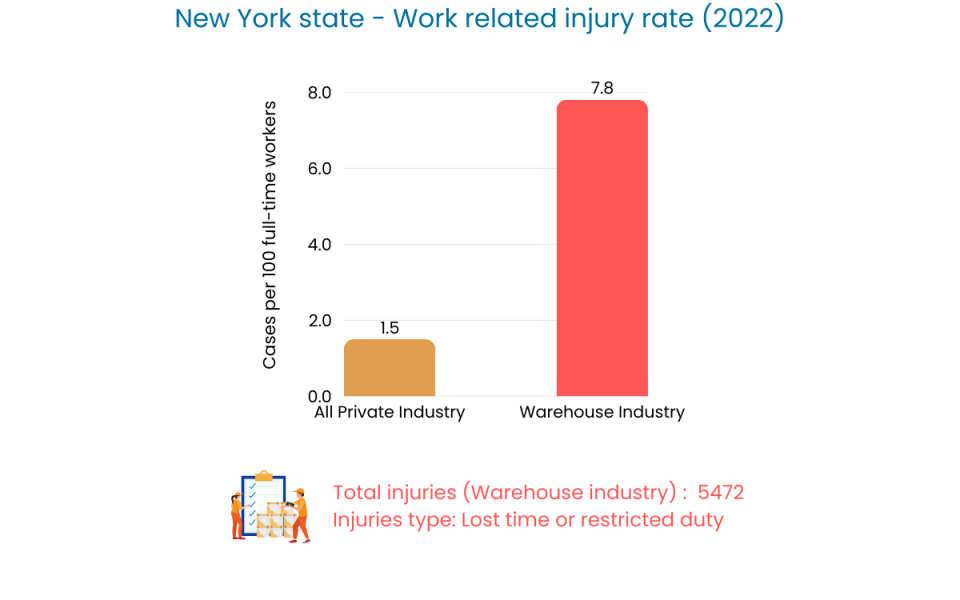
- In 2022, New York's warehouse industry reported an injury rate of 7.8 cases per 100 full-time workers, more than five times the state’s private industry average (1.5 cases per 100 full-time workers). Out of a total of 5,472 worker injuries, the most common types of work-related serious injuries reported by employers in the warehouse sector were musculoskeletal injuries.
- The frequency and severity of injuries in New York's warehouses are having a direct impact on public health and safety.
- The high rate of injuries in warehouses could lead to service disruptions, jeopardizing the health and safety of communities.

Definition of WRMSD
The act has defined "Work-related musculoskeletal disorders" (WRMSD) as work-related conditions (injuries, illness or disorders) of the muscles, nerves, tendons, ligaments, joints, cartilage of the body's musculoskeletal system including the muscles, nerves, tendons, ligaments, joints, cartilage and spinal discs of the upper and lower limbs, neck, shoulders, and back that:
- (a) are the result of an exposure in the work environment during the performance of work that either causes or contributes significantly to the resulting condition or makes worse or longer-lasting a pre-existing condition;
- (b) are caused by ergonomic risk factors that include, but are not limited to, rapid pace, forceful exertions, extreme or static postures, repetitive motions, direct pressure, contact stress, vibration or cold temperatures; or
- (c) are not the result of any instantaneous non-exertion event, such as slips, trips, or falls.
Injury Reduction Program
Some important sections of the act are summarized below:
Employer Requirements:
Employers must establish and implement an injury reduction program to identify and minimize risks of musculoskeletal disorders (MSDs) among workers performing manual materials handling tasks.
The program must include:
- Worksite evaluations,
- Exposure controls (e.g., ergonomic risk factors like work pace),
- Employee training,
- On-site medical and first aid practices, and
- Employee involvement.
Worksite Evaluations:
Employers must ensure written worksite evaluations are conducted by a qualified ergonomist for each job, process, or operation (or a representative sample of identical tasks).
Risk Factor Identification:
Evaluations must identify risk factors that have caused or are likely to cause musculoskeletal injuries and disorders. Risk factors include, but are not limited to:
- Rapid work pace,
- Forceful exertions,
- Repetitive motions,
- Twisting, bending, and awkward postures,
- Combinations of these factors.
Assessment of Adverse Actions:
Worksite evaluations must assess whether employees exposed to risk factors face potential adverse actions, such as discipline or termination, due to employer-imposed quotas.
Employee Input:
Worksite evaluations must include input from workers or employee-led safety committees about potential risk factors and workplace changes to reduce them.
Notification and Accessibility:
Employers must notify workers in writing of evaluation results, maintain accessible copies in the warehouse, and ensure they are readily available to workers.
Initial and Ongoing Evaluations:
An initial worksite evaluation must be conducted, with evaluations reviewed and updated at least annually. A new risk factor analysis must be performed within 30 days whenever a new job, process, or operation is introduced that could increase the risk of musculoskeletal disorders.
Review by Ergonomist:
A worksite evaluation must be reviewed by a board-certified ergonomist if an employee-led workplace safety committee submits a written request based on a material concern. If no such committee exists, the review is required when any employee-led committee formally recommends it due to a material concern.
Correction of Risk Factors:
Employers must promptly correct risk factors identified as causing or likely to cause work-related musculoskeletal disorders (WRMSDs). For corrections requiring more than 30 days, employers must provide a schedule for proposed corrections.
Minimizing Exposure:
If employers are unable to eliminate identified risk factors, the exposure should be minimized to the extent feasible. Employers can consider:
- Engineering controls: Redesigning workstations to change shelving heights, provide adjustable fixtures, or redesign tools; and
- Administrative controls: Implementing job rotation to reduce exposure to risk factors, reducing work pacing, or providing additional work breaks.
Employee Training:
Employers must provide injury reduction training to all employees involved in performing manual materials handling jobs and tasks. The training should include:
- Early symptoms of WRMSDs,
- Risk factors, and
- Methods to reduce exposure.
How ErgoEdge could help?
- Fast, accurate, and comprehensive assessment of worksites with AI-powered solution
- Measure the risk factors like Repetitive motions, frequency, force, awkward postures etc.
- A collaborative platform to track the exposure, changes, and improvements
- Train new and existing employees with real-time video demo of good ergonomics practices
- Reports and dashboards at each level of the organization
References:
Bill signed by the Governor on 12/12/2024
https://nyassembly.gov/leg/?term=2023&bn=S05081
Amendment signed on 02/14/2025
https://nyassembly.gov/leg/?term=2025&bn=S00808
Section 780 of Labor law (Definitions)
https://www.nysenate.gov/legislation/laws/LAB/780
Section 786 of Labor law (Unlawful retaliation)
https://www.nysenate.gov/legislation/laws/LAB/786
Section 789 of Labor law (Injury reduction program)
https://www.nysenate.gov/legislation/laws/LAB/789


