
Repetitive Work in Food Processing Causes MSDs. ErgoEdge Finds Them First.
Food processing workers perform the same motions thousands of times per shift -- deboning, portioning, filling, and packing. This repetition is the leading driver of upper limb MSDs in the industry. ErgoEdge assesses the risk from video recorded on a smartphone, scoring each task against RULA, ART, and REBA standards without disrupting the production line.
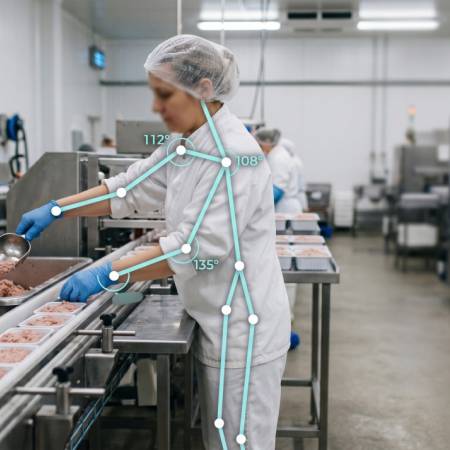
How ErgoEdge Works in Food Processing
ErgoEdge assesses ergonomic risk in food processing from video recorded on a standard smartphone or tablet. The AI scores repetitive upper limb strain using standards like RULA and ART, whole-body posture risk using REBA, and manual handling tasks using NIOSH and MAC -- identifying the highest-risk tasks on deboning, portioning, filling, and packing lines.
Top Ergonomic Risks in Food Processing
Understanding the highest-risk tasks is the first step to prevention. These are the primary musculoskeletal disorder (MSD) drivers ErgoEdge addresses in Food Processing environments.
Repetitive Upper Limb Strain on Processing Lines
Deboning, portioning, trimming, and filleting require thousands of repetitive wrist, hand, and forearm movements per shift. ErgoEdge applies ART (Assessment of Repetitive Tasks) to score cumulative upper limb MSD risk at each station and identify which tas
Awkward Postures at Fixed-Height Processing Stations
Processing line heights are designed for the product, not the worker. Sustained forward reach, lateral trunk lean, and neck flexion at cutting and filling stations are primary REBA risk drivers. Workers in cold environments compound this by hunching to ret
Cold Environment Posture Adaptation
Workers in chilled and frozen processing areas adopt tighter, more restricted postures to manage cold exposure. This adaptation reduces joint range of motion and increases MSD risk over consecutive shifts. ErgoEdge REBA scoring captures this posture patter
Prolonged Standing and Static Load
Fixed-line processing requires workers to stand in the same position for extended periods. Static posture on hard floors causes lower limb and lower back fatigue that progressively worsens posture quality across the shift. REBA assessment identifies statio
Lifting and Carrying Heavy Containers and Crates
Moving raw material crates, filled containers, and packaged product involves repeated lifting and carrying tasks. ErgoEdge scores these against the NIOSH Lifting Equation and MAC (Manual Handling Assessment Charts) to identify loads and frequencies that ex
How ErgoEdge Addresses Food Processing Ergonomic Risks
ErgoEdge gives food processing EHS teams the ability to assess ergonomic risk across every task on the production line -- from deboning and portioning to filling, sealing, and packing -- using video recorded on a standard smartphone. No ergonomist required on-site. No wearables on workers. No disruption to the production line.
- ART (Assessment of Repetitive Tasks) scoring for high-frequency upper limb work at deboning, trimming, and packing stations
- RULA assessment for upper limb and neck posture risk at fixed-height processing and filling lines
- REBA whole-body posture scoring -- works accurately in chilled and cold processing environments
- NIOSH Lifting Equation and MAC assessment for crate lifting, container carrying, and goods-in tasks
- Station-level and site-level dashboards showing MSD risk by task, workstation, and shift
- PDF and Excel reports for ISO 45001, HSE compliance, and retailer code of practice documentation
Why Food Processing Has One of the Highest MSD Rates of Any Industry
Food processing workers perform some of the most repetitive physical tasks in any industrial sector. A deboning operative may make the same cutting motion more than 10,000 times in a single shift. A packing line worker reaches, places, and stacks continuously for hours at a fixed-height station that was not designed around their body dimensions. A chill room operative lifts heavy containers while wearing insulating clothing that restricts movement and worsens already compromised posture.
The result is an MSD injury rate that consistently sits among the highest across all manufacturing and processing sectors. Upper limb disorders -- carpal tunnel syndrome, tendinitis, shoulder impingement -- are endemic on processing lines. Lower back injuries from lifting and sustained static posture are the leading cause of long-term absence. And because workers often do not report early symptoms under production pressure, injuries become serious before they are treated.
How ErgoEdge Addresses Food Processing Ergonomic Risk
ErgoEdge makes systematic ergonomic risk assessment practical on a food processing line. A supervisor records a short video of a worker performing a specific task -- deboning, portioning, filling, sealing, or packing -- on a standard smartphone or tablet. The video is uploaded to ErgoEdge via the mobile or web app. Within minutes, the platform returns a full assessment scored against the appropriate standard: ART for repetitive upper limb tasks, RULA for neck and upper limb posture, REBA for whole-body posture, and NIOSH or MAC for lifting and carrying tasks.
Crucially, ErgoEdge works accurately in the conditions that make food processing ergonomics difficult to assess manually. Cold and chilled environments, variable lighting, workers in PPE and insulating workwear -- the platform identifies and tracks the operator throughout the video and delivers consistent risk scores regardless of environmental conditions.
From Individual Task Assessment to Line-Level Risk Management
The management dashboard aggregates assessment data across every station, line, and site. EHS teams can see which stations carry the highest cumulative upper limb risk, which shifts show the highest REBA scores, and how risk changes over time as workstation modifications are implemented. This cross-line visibility allows food processing EHS managers to make the case for capital investment in workstation redesign with quantified risk data rather than incident history.
Assessment reports export to PDF and Excel for use in ISO 45001 management reviews, HSE compliance documentation, and retailer codes of practice. For food processors operating under BRC, SALSA, or similar audit frameworks, documented evidence of systematic ergonomic risk assessment is increasingly required -- ErgoEdge provides this evidence at scale without requiring specialist ergonomist time for every assessment.
Frequently Asked Questions
How does ErgoEdge assess ergonomic risk on a food processing line?
A supervisor records a short video of a worker performing a specific task -- deboning, portioning, filling, or packing -- using a standard smartphone or tablet. The video is uploaded to ErgoEdge via the mobile or web app. ErgoEdge scores the task automatic
Which assessment methods does ErgoEdge use for food processing tasks?
ART (Assessment of Repetitive Tasks) for high-frequency upper limb work such as deboning, trimming, and packing. RULA for upper limb and neck posture at processing stations. REBA for whole-body posture assessment including tasks in chilled environments. N
Can ErgoEdge work in chilled or cold food processing environments?
Yes. ErgoEdge processes video recorded in any lighting and temperature condition, including chilled and frozen processing areas. The platform is particularly valuable in cold environments because workers in these conditions adopt posture patterns that sign
How does ErgoEdge help food processors comply with health and safety regulations?
ErgoEdge generates RULA, REBA, ART, and NIOSH assessment reports exportable to PDF and Excel. These provide documented evidence of systematic ergonomic risk evaluation -- a requirement under ISO 45001, HSE guidelines, and many food industry retailer codes
Certified Platform



ISO 27001:2022 · NVIDIA Cloud Validated · IAS Accredited