
Custom Ergonomic Standards at Toyota, BMW, VW & Ford
Custom ergonomic standards are proprietary risk-assessment frameworks that organisations build in-house to evaluate musculoskeletal disorder (MSD) risk in ways generic tools like RULA, REBA, or the NIOSH lifting equation cannot. Toyota, Volkswagen, Audi, Fiat, Ford, and BMW each developed their own — driven by the need for process-specific thresholds, comparable scoring across plants, and direct integration with engineering and production design. Beyond automotive, Boeing and Amazon have built parallel systems for aerospace and logistics. This piece breaks down the most influential standards in use today, the science behind them, where they fall short, and how AI-powered video analytics now extends — not replaces — them.
Why Generic Standards Like RULA & REBA Hit a Wall in Real Plants
Custom ergonomic standards are proprietary risk-assessment frameworks built by individual organisations to evaluate musculoskeletal load in ways generic tools like RULA or REBA cannot. They typically combine posture analysis, force, repetition, cycle time, and process-specific thresholds — calibrated to a company’s actual production environment.
The reason these standards exist is structural, not preferential. RULA was published by McAtamney and Corlett in 1993 to assess upper-limb strain at single moments. REBA followed in 2000 for full-body postures. The NIOSH lifting equation calculates load thresholds for one task at a time. None of them were designed to evaluate the cumulative load of a 60-second cycle, repeated 480 times per shift, across a multi-station vehicle assembly line.
Generic standards diagnose the symptom — a poor posture in a moment. Custom standards are designed to diagnose the system — the cycle, the cumulative load, the tool, the workstation, the supplier-specified part. That difference is why every major automotive OEM eventually built its own.
What the Research Says About Standard Variability
Before reviewing the case studies, it’s worth grounding the case for custom standards in what peer-reviewed research has found about the generic ones.
A 2022 systematic literature review by Dohyung Kee in the International Journal of Environmental Research and Public Health compared OWAS, RULA, and REBA across multiple studies and reported correlation coefficients between the three methods ranging from 0.415 to 0.785, with most studies below 0.5. In plain terms: the three most widely-taught observational standards produce materially different risk scores when applied to the same postures. There is no consistent agreement between them.
Inter-rater reliability is similarly modest. Studies of new and trained raters using these methods have reported kappa values in the range of 0.54 to 0.60 — meaning two trained ergonomists scoring the same video frequently produce different action levels. This is a known structural property of observational scoring, not a quality problem with any individual practitioner. It’s also why Toyota’s senior ergonomists run yearly recalibration audits across European plants — to manage the variability rather than pretend it doesn’t exist.
If three published standards disagree on the same posture, no generic standard alone can anchor a corporate MSD program. That single fact explains why advanced organisations have spent decades building proprietary frameworks calibrated to their own processes.
A Tour of Real Custom Ergonomic Standards in Industry
Toyota — JT/SJT and TEBA
Toyota’s ergonomic risk management is anchored in the Joshi-ten (JT) and Shisei Juryo-ten (SJT) system, introduced into Toyota’s European car plants in 1997, as documented by IOSH Magazine’s reporting on Toyota’s ergonomic process. JT focuses on upper-body postures and how they interact with the production process. It scores critical points such as elbow-above-shoulder-height movements, hand-tool weight (with 2.5 kg as the trigger for engineered replacement), wrist postures, push force from thumb and finger, and neck deviation. SJT covers the lower body — back bend, weight lifted, body twist, and combined twist-and-bend. Together, JT/SJT comprises four scoring elements: arm raise; arm raise and hand postures; back bend and weight; and back bend postures.
In Australia, Toyota built a parallel tool — the Toyota Ergonomic Burden Assessment (TEBA) — described in Manufacturers’ Monthly as a unique program ergonomically assessing online and logistics processes through technical video analysis combined with practical reviews by team members and group leaders.
Toyota has continuously layered technology onto JT/SJT. In 2013, the company piloted dorsaVi wearable sensors to assess logistics movements. More recently, Toyota integrated XSENS motion-capture sensors with JT/SJT scoring, generating a digitised avatar of the operator from body measurements and evaluating posture against the standard. The intent was specific: improving the accuracy of an assessment system Toyota’s leadership knew had subjective elements.
Volkswagen, Audi, Fiat & the EAWS Lineage
The Ergonomic Assessment Worksheet (EAWS) is the most widely deployed custom standard in European automotive — and its lineage is worth understanding. EAWS is an extension of the Automotive Assembly Worksheet (AAWS), itself built on General Motors Europe’s New Production Worksheet (1997) and Porsche’s designCheck, developed in parallel. EAWS proper was developed between 2006 and 2008 by international experts in occupational health, biomechanics, and industrial engineering, coordinated by the International MTM Directorate, as documented in Schaub et al.’s foundational 2012 paper in the International Journal of Human Factors Modelling and Simulation.
EAWS scores across four sections covering working postures, forceful actions, manual handling of loads, and upper-limb repetitive load. Stress points are aggregated and reported on a traffic-light scheme — red, yellow, green — making the output legible to non-ergonomists. EAWS aligns with ISO 11226 and ISO 11228 and is implemented across Volkswagen, Audi, and Fiat (via the Ergo-UAS system), and integrates with digital human models like Jack and the EMA / MTMergonomics planning platforms.
Ford Motor Company — GSPAS, Jack/Jill & the Sue Rodgers Backbone
Ford’s ergonomic standards live inside the Global Study and Process Allocation System (GSPAS) — Ford’s global repository for standardised engineering processes, parts, tools, and labor times across all assembly plants. Two AI-driven ergonomic analysis systems run inside GSPAS, automatically flagging risk operations whenever manufacturing parameters change such as line speed, product mix, or allocation. This is documented in detail in AI Magazine’s coverage of Ford’s deployed ergonomics application.
The methodological backbone draws from multiple validated sources, as reported by EHS Today on Ford’s Dearborn ergonomics lab: the Sue Rodgers method (effort × duration × frequency, expressed as a three-digit score), the NIOSH lifting equation, the University of Michigan’s 3D Static Strength Prediction Program for joint torque, HandPak from Dr. Jim Potvin at McMaster University for upper-extremity assessment, and Siemens’ Tecnomatix-based virtual humans Jack and Jill for pre-build simulation.
Allison Stephens, Ford’s global technical specialist in assembly ergonomics, has reported a greater-than-70% reduction in injury rates since 2003, with a corporate goal of zero “red” or unacceptable ergonomic issues entering production.
BMW Group — SERA and DWSM
The BMW Group operates an internally developed Safety and Ergonomics Risk Assessment (SERA) system — a centralised, web-based platform designed to harmonise ergonomic assessment with classic hazard and risk assessment across BMW’s global plant network. SERA’s documented purpose is internationally comparable risk management, and the system builds on Key Indicator Method (KIM) posture factors. This is described in research published through the International Occupational Ergonomics and Safety Conference (Dehghani et al., 2021; Snell et al., 2021).
On top of SERA, BMW has built Digital Workplace Stress Management (DWSM) — a digitised assessment system that combines motion capture with a force-measuring glove, capturing stresses that motion data alone cannot detect, such as grip force and finger load. The combination is significant: BMW’s own engineers acknowledge that vision and motion data alone don’t capture the full picture, and they engineered around that limitation rather than ignoring it.
BMW has also invested in adjacent ergonomic engineering. In 2014, in partnership with the Technical University of Munich’s Department of Ergonomics, BMW began producing 3D-printed custom thumb orthoses — flexible finger cots fitted to each worker’s hand — for plug-fitting stations at the Munich plant, as reported by EHS Today. The company has also developed ergonomic workwear with elasticised inserts around shoulders and lower legs.
A Note on Daimler — Custom Implementation, Not Custom Method
Daimler is more guarded about a single branded methodology, but the public record is concrete. Daimler’s 2019 and 2020 sustainability reports describe a digitised IT-based ergonomics assessment system, rolled out in 2018, that scores workstations on a traffic-light scheme. The JobMatch tool matches performance-restricted employees to workstations whose ergonomic profile fits their capabilities, and the Daimler GesundheitsCheck ties health checks into the assessment loop. Pirger, Wittemann, Bürkner & Gutschalk’s 2017 paper in the Stuttgarter Symposium proceedings (Springer Vieweg) documents Daimler’s holistic approach to ergonomics in product development.
Methodologically, Daimler appears to use EAWS-aligned scoring — consistent with the German automotive standard — wrapped in proprietary IT and JobMatch logic. Unlike BMW or Toyota, there is no single uniquely-named corporate standard documented in the public record. Daimler is best understood as a custom-implementation case, not a custom-method one.
Beyond Automotive: Boeing’s BEES and Amazon’s MSD Program
Custom standards are not exclusive to automotive. Two non-automotive cases are worth examining.
Boeing operates the Boeing Enterprise Ergonomics System (BEES), its enterprise-wide tool for documenting detailed ergonomic evaluations, integrated with its Occupational Health & Safety Management System and OHSAS 18001. Boeing’s 2019 application for the Robert W. Campbell Award details BEES as part of a broader hazard recognition framework. The company has published case studies — including its Stringer Hand Finish ergonomics improvement workshop, covered by Ergoweb — that show a participatory, cross-functional team approach. Boeing’s exoskeleton research has involved partnerships with NIOSH, NIST, and the US Navy, Air Force, and Army.
Amazon has built proprietary ergonomic technology under its operations program. ErgoPick is an AI-enabled system designed to ensure employees pick within their ergonomic power zone — the area between the shoulder and mid-thigh. Robotic systems like Robin, Cardinal, and Sequoia handle repetitive and strenuous tasks; Sequoia delivers inventory at an ergonomically friendly height. Amazon also funds the MSD Solutions Lab at the National Safety Council. According to Amazon’s 2024 workplace safety report, the company’s MSD recordable incident rate has improved 32% over five years, though MSDs still represent 57% of all recordable injuries at Amazon.
A caveat is appropriate here. Amazon’s program operates under significant regulatory pressure. A December 2024 corporate-wide settlement with the US Department of Labor’s OSHA requires Amazon to conduct annual ergonomic risk assessments at each facility, designate Site Ergonomics Leads, and meet biannually to review leading and lagging MSD indicator data. The program is documented in detail and the technology investments are real, but Amazon’s framework is not held up here as equivalent to Toyota’s three decades of disciplined kaizen-anchored practice. It is, however, the most detailed publicly-documented logistics-sector custom ergonomic program in operation today.
Honourable Mentions
GM Europe’s New Production Worksheet and Porsche’s designCheck deserve a mention — both were absorbed into the EAWS lineage and represent the cross-pollination that gave EAWS its multi-OEM credibility. OWAS itself originated as a custom standard at Ovako Oy, a Finnish steel company, in 1977 before becoming public domain. Healthcare has sector-wide consensus standards rather than single-organisation proprietary frameworks — the Society of Diagnostic Medical Sonography’s 2021 industry standards for prevention of work-related MSDs in sonography, and the Facility Guidelines Institute’s patient handling and movement assessment white paper, are both useful reference points.
The Research & Engineering Behind These Standards
What separates a custom standard from a checklist is the depth of research it sits on. The shared DNA across JT/SJT, EAWS, GSPAS, and SERA includes several common elements.
Biomechanical thresholds anchored in research. Toyota’s 2.5 kg hand-tool limit is not arbitrary. It reflects the load at which sustained one-handed manipulation produces measurable shoulder and forearm strain — which is why exceeding it triggers an engineered tool support, not a “be careful” memo.
MTM (Methods-Time Measurement) integration. EAWS is paired with MTM-UAS so that posture time is tied directly to standardised basic movements — grasp, move, walk, position. This lets ergonomists score posture-time accurately at the planning stage, before a workstation is built, closing the gap between time study and risk study.
Multi-task accumulation models. Ford’s framework uses Recommended Cumulative Recovery Allowance (RCRA) and Fatigue Failure theory-based models to recommend job-rotation schedules. The premise is biomechanically honest: no single task scored in isolation tells the truth about MSD risk.
Traffic-light reporting. EAWS’s red/yellow/green output, BMW’s SERA scoring, and Daimler’s digitised system all share this design choice. Translation is part of the methodology — making the data legible to a supervisor, a project engineer, or a procurement manager choosing a tool.
Closed-loop engineering integration. Ford integrates ergonomic requirements into product design specifications. Toyota uses scores as supplier acceptance criteria. VW and Fiat plants gate tooling approvals on EAWS results. BMW’s SERA harmonises ergonomic with hazard assessment. The standard is not a report — it is a control point in the engineering process.
| Standard | Origin | Owner | Scope | Output | Anchor Tools / Sources |
|---|---|---|---|---|---|
| JT/SJT + TEBA | 1997 (EU plants); Australia variant | Toyota | Upper + lower body, 4 scoring elements | Burden score; team + group leader review | dorsaVi wearables, XSENS motion capture |
| EAWS | 2006–2008 (built on AAWS, GM-Europe NPW, Porsche designCheck) | Coordinated by IMD; used by VW, Audi, Fiat | Whole-body + upper limbs; postures, forces, handling, repetition | Stress points → red/yellow/green | MTM-UAS, Jack DHM, EMA Work Designer; aligned with ISO 11226/11228 |
| Ford GSPAS Ergonomics | UAW-Ford / U. Michigan partnership; continuous | Ford Motor Company | Full assembly process, virtual + physical | AI-driven risk flagging; goal-zero “red” issues | Sue Rodgers method, NIOSH lifting, UMich 3DSSPP, HandPak, Jack/Jill |
| BMW SERA + DWSM | Internal development; DWSM more recent | BMW Group | Whole-body, force-sensitive | Centralised scoring + traffic-light | KIM posture factors, motion capture, force-measuring glove |
Why Custom Standards Work — The Real Advantages
Process specificity. A custom standard knows what a “good” station looks like in your operation. Generic standards score in the abstract; custom standards score against a benchmark calibrated to actual cycle times, tool weights, and stock placement on your line.
Comparable data across plants. Toyota Motor Europe explicitly adopted JT/SJT as a corporate standard so risk scores from a UK plant could be benchmarked against a French or Polish one, as documented in IOSH Magazine’s reporting. Comparability is what unlocks corporate-level capital allocation — exoskeletons here, lift assists there, redesign in another plant.
Engineering integration. Custom standards are baked into design. Risk gets engineered out before it generates a workers’ compensation claim, not after.
Cultural traction. When the system is yours, line teams treat it as theirs. Toyota’s kaizen culture pulls JT/SJT into daily practice; operators warm up before shifts knowing why. That ownership is hard to replicate with an off-the-shelf form.
Auditability. Yearly internal audits — Toyota’s senior ergonomists still travel to European plants to recalibrate scoring discipline — create a feedback loop that off-the-shelf assessments cannot sustain.
Where Custom Standards Hit Their Limits
Every system reviewed here is admirable. Every one of them also has known limitations — and the engineers who built them know it. Honest naming of these limits is what makes the case for the next operational layer.
Sampling, not continuous monitoring. A trained ergonomist scoring an EAWS or JT/SJT analysis observes a representative cycle. That score then represents an entire shift, week, or month. Real production drifts: tools get re-routed, line speeds shift, operators rotate, fatigue accumulates. The score becomes stale fast.
Inter-rater subjectivity. Even with extensive training, two ergonomists scoring the same video can produce different results. Toyota’s senior ergonomists run yearly audits in part to recalibrate assessors — the variability is well-understood inside these companies, not an outsider’s strawman. The Kee 2022 review cited earlier puts numbers on this: kappa values in the 0.54–0.60 range across RULA, REBA, and OWAS.
Manual video analysis is slow and expensive. Toyota’s documented UK process: video the cycle, bring it back to the office, score it manually, reconcile with the line ergonomist. A trained scorer typically completes 4–6 stations per day. A plant with 200 stations is on a 40-day cycle for one round — by which point production has already moved on.
Sample-size limits. Because manual scoring is expensive, organisations score some operators on some tasks during some time windows. The MSD risk in everything that wasn’t observed remains unmeasured.
Expertise dependence. Toyota Motor Europe ran week-long intensives to train plant teams; Ford’s Dearborn lab employs a ten-person ergonomics team. Replicating that depth — especially in mid-sized manufacturers without a corporate ergonomics function — is a structural barrier.
The intervention lag. From observation to scored assessment to engineering change typically takes weeks. By the time a yellow score becomes a red one in the data, an operator may have already exceeded their cumulative load threshold.
Every system here is admirable, and every limitation here is known by the engineers who built them. The next layer of improvement is not a new standard. It is a new way of running the standards that already work.
How AI Video Analytics Extends Custom Standards (Not Replaces Them)
This is the operational gap an AI-powered video analytics platform is built to close. The framing matters: AI is not a competing standard. It is the missing layer that lets a custom standard run continuously, consistently, and at scale.
The credibility of this claim now rests on peer-reviewed evidence, not vendor assertion. A 2025 case study by Breznik, Buchmeister & Vujica Herzog in Sensors compared Xsens motion capture combined with Process Simulate V16 software against expert manual EAWS scoring on an assembly line. The study reported strong agreement on whole-body EAWS sections, with discrepancies on upper-limb scoring requiring further validation. A 2024 paper in Scientific Reports validated multiple computer-vision-based ergonomic risk assessment pipelines in real manufacturing environments, with vision-based RULA and REBA scoring achieving 60–80% accuracy on risk levels across studies by Generosi et al., Lin et al., and others.
What this enables in practice:
Continuous capture, not sampling. Vision-based platforms analyse posture, force application, repetition, and cycle time from existing factory cameras throughout every shift. Every operator, every cycle, every station — observed without wearables, without operator instrumentation.
Standardisation removes inter-rater variance. A computer-vision model scoring against a defined ruleset produces the same score for the same posture every time. The ergonomist’s expertise shifts upstream, to designing thresholds and interventions, instead of being consumed by repetitive scoring.
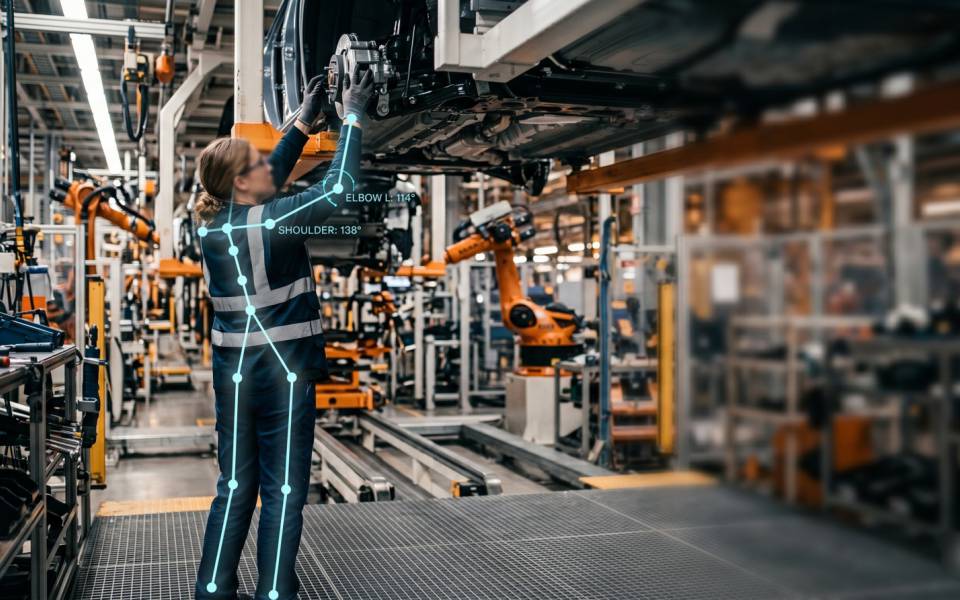
Compatibility with custom rule sets. A platform built on machine vision and skeletal tracking can score against any deterministic ruleset. JT/SJT thresholds — elbow-above-shoulder, 2.5 kg tool, neck deviation, back bend — are exactly the kind of geometric and force-time conditions a vision model evaluates well, which means a corporate standard can be encoded as an additional rule layer.
Built on existing infrastructure. Most plants already have cameras for quality and safety. Video analytics platforms run on that footage — no operator instrumentation, no compliance friction, no privacy redesign.
Real-time alerts and trend analytics. Cumulative load is the silent killer in MSD progression. Continuous data exposes trend lines: a station drifting from green to yellow over six weeks is visible before it generates a claim — which is the only window in which prevention is cheaper than treatment.
Audit trail. Continuous, time-stamped, video-anchored data gives EHS leaders the documentation regulators and corporate boards increasingly want.
In short: custom standards define the rules; AI video analytics enforces them in real time, across the whole plant, every day.
Beyond the open standards, ErgoEdge is built to support customer-defined corporate standards. Where an organisation has already invested in a proprietary methodology — JT/SJT, an EAWS-aligned ruleset, an internal scorecard — the platform’s role is to operationalise that standard, not replace it.
A Practical Hybrid Model: Custom Logic + Continuous AI Capture
For organisations not at Toyota or Ford scale, the path forward isn’t to build a standard from scratch over thirty years. It is to:
- Adopt or adapt a recognised framework — RULA, REBA, NIOSH, MAC, ART, or an EAWS-aligned ruleset — as the floor.
- Layer in process-specific thresholds for the operations that matter most: tool weight, reach envelope, cycle force, repetition rate, awkward-posture dwell time.
- Operationalise with AI video analytics so the assessment runs continuously instead of episodically.
- Close the loop into engineering. Every red flag has to flow back into workstation redesign, supplier specifications, and operator rotation. Without the loop, the data is decoration.
That sequence captures most of the value Toyota, VW, Ford, and BMW built over decades — without the institutional weight of a ten-person Dearborn ergonomics lab.
If your organisation runs a custom ergonomic standard — or is considering building one — the encoding details are best discussed against your specific methodology. CerebrumEdge works with customers to map their existing standard onto the platform, including the parts that benefit from human input alongside automated detection. Talk to our team →
Frequently Asked Questions
What is the difference between RULA, REBA, and a custom ergonomic standard?
RULA and REBA are general-purpose, published assessment methods that score posture-based MSD risk at a single moment. A custom standard is a proprietary framework built by an organisation to capture industry-specific factors generic methods don’t — cycle-time accumulation, tool-specific thresholds, plant-comparable scoring, and integration with engineering and production planning.
Which companies use custom ergonomic standards?
Toyota (JT/SJT and TEBA), Volkswagen, Audi, and Fiat (EAWS / Ergo-UAS), Ford (GSPAS-integrated systems combining the Sue Rodgers method, NIOSH lifting, the University of Michigan 3DSSPP, and HandPak), and BMW (SERA and DWSM). General Motors Europe and Porsche developed earlier internal tools that were absorbed into the EAWS lineage. Boeing uses BEES in aerospace, and Amazon runs ErgoPick and a corporate ergonomics program in logistics.
Is EAWS an international standard?
EAWS is widely adopted internationally in automotive and aerospace, and it is aligned with ISO 11226 and ISO 11228. It is not itself a regulatory standard like ISO; it is a de facto industry standard maintained by the MTM community and Fondazione Ergo.
Can AI replace ergonomists?
No. AI video analytics removes the manual, repetitive scoring work — but the ergonomist’s expertise in defining thresholds, designing interventions, and translating data into engineering changes remains central. The shift is from doing the scoring to interpreting it at scale.
How does AI know what “high risk” looks like?
Modern computer-vision platforms detect skeletal posture frame by frame and score it against a deterministic rule set — RULA angle thresholds, NIOSH load thresholds, or custom company rules — without subjective interpretation. Output is repeatable: the same posture produces the same score every time.
What is the ROI on continuous ergonomic monitoring?
NIOSH estimates U.S. work-related MSDs cost between $13 and $54 billion annually, with direct cost per case ranging from $15,000 to $85,000 — and indirect costs typically two to three times higher. Continuous monitoring shortens the time from risk emergence to intervention, which is the single variable that drives most of the savings.
Where This Is Heading
The next decade of industrial ergonomics will not be a fight between custom standards and AI. It will be a convergence: the rule sets that Toyota, Ford, VW, and BMW spent decades refining become runnable code on top of vision platforms that observe everything, all the time. Organisations that move first compound a lead — not just in injury reduction, but in production design itself.
If you’d like to see how ErgoEdge can encode your existing standard — or operationalise a generic framework — against your plant’s actual footage, Request a demo →
References
- Kee, D. (2022). Systematic Comparison of OWAS, RULA, and REBA Based on a Literature Review. International Journal of Environmental Research and Public Health, 19(595). https://www.mdpi.com/1660-4601/19/1/595
- Breznik, M., Buchmeister, B., & Vujica Herzog, N. (2025). Evaluation of the EAWS Ergonomic Analysis on the Assembly Line: Xsens vs. Manual Expert Method—A Case Study. Sensors, 25(4564). https://www.ncbi.nlm.nih.gov/pmc/articles/PMC12349331/
- Validation of computer vision-based ergonomic risk assessment tools for real manufacturing environments. Scientific Reports (2024). https://www.nature.com/articles/s41598-024-79373-4
- Schaub, K., Mühlstedt, J., Illmann, B., Bauer, S., Fritzsche, L., Wagner, T., & Bullinger-Hoffmann, A. C. (2012). Ergonomic assessment of automotive assembly tasks with digital human modelling and the ‘Ergonomics Assessment Worksheet’ (EAWS). International Journal of Human Factors Modelling and Simulation, 3(3/4), 398–426.
- Schaub, K., Kugler, M., Bierwirth, M., Sinn-Behrendt, A., & Bruder, R. (2012). Prevention of MSD by means of ergonomic risk assessment (tools) in all phases of the vehicle development process. WORK. https://pubmed.ncbi.nlm.nih.gov/22317397/
- Pirger, A., Wittemann, P., Bürkner, S., & Gutschalk, T. (2017). Ergonomics in the product development process at Daimler AG: A holistic approach. In Bargende, M., Reuss, H.-C., & Wiedemann, J. (eds.), 17. Internationales Stuttgarter Symposium. Springer Vieweg, Wiesbaden. https://doi.org/10.1007/978-3-658-16988-6_98
- Toyota: Critical Moves. IOSH Magazine. https://www.ioshmagazine.com/toyota-critical-moves
- Toyota Motor Corporation. Manufacturers’ Monthly. https://www.manmonthly.com.au/toyota-motor-corporation/
- Ergonomics Analysis for Vehicle Assembly Using Artificial Intelligence. AI Magazine. https://dl.acm.org/doi/abs/10.1609/aimag.v26i3.1824
- At Ford, Ergonomics Meets Immersive Engineering. EHS Today. https://www.ehstoday.com/health/article/21911540/at-ford-ergonomics-meets-immersive-engineering
- Ford Motor Co on the safety of automakers and the ASE. FSM Direct. https://fsmdirect.com/jack-mac-and-jill/
- Ergonomics Pays Off For The Boeing Company. Ergoweb. https://ergoweb.com/ergonomics-pays-off-for-the-boeing-company/
- EHS Excellence in Boeing’s Second Century (Robert W. Campbell Award application, 2019). https://www.campbellaward.org/wp-content/uploads/2019/01/RWC-Boeing-Application.pdf
- BMW Uses 3-D Printing Methods to Make Customized Ergonomic PPE for Assembly Workers. EHS Today. https://www.ehstoday.com/safety/article/21916416/bmw-uses-3-d-printing-methods-to-make-customized-ergonomic-ppe-for-assembly-workers
- Digital Workplace Stress Management: A System for Digital Ergonomics Assessment in the BMW Group. Proceedings of the International Occupational Ergonomics and Safety Conference. https://www.researchgate.net/publication/365405236
- Safe and healthy work. Daimler Sustainability Report 2019. https://sustainabilityreport.daimler.com/2019/reporting/people/safe-and-healthy-work.html
- Occupational health and safety. Daimler Sustainability Report 2020. https://sustainabilityreport.daimler.com/2020/reporting/people/occupational-health-and-safety.html
- US Department of Labor announces settlement with Amazon requiring corporate-wide ergonomic measures at facilities across the country (Dec 19, 2024). OSHA. https://www.osha.gov/news/newsreleases/osha-national-news-release/20241219
- Amazon’s safety performance continues to improve year over year (2024). About Amazon. https://www.aboutamazon.com/news/workplace/amazon-workplace-safety-performance-2024


