ISO 11228-1 and the NIOSH lifting equation
ISO 11228-1 is the lifting standard, and the Revised NIOSH Lifting Equation is the calculation inside it. This covers what the standard applies to, how the equation is built, and the multi-task indices the 2021 edition added — the part most existing assessment methodologies are missing.
How this reference is verified
Scope and edition claims were checked against the ISO catalogue entry and the published foreword in September 2026. The multiplier set described below is the RNLE as published by NIOSH; ISO 11228-1:2021 extends its application rather than redefining it. Threshold and annex details should be read in the standard itself before you build a procedure on them.
What ISO 11228-1 covers
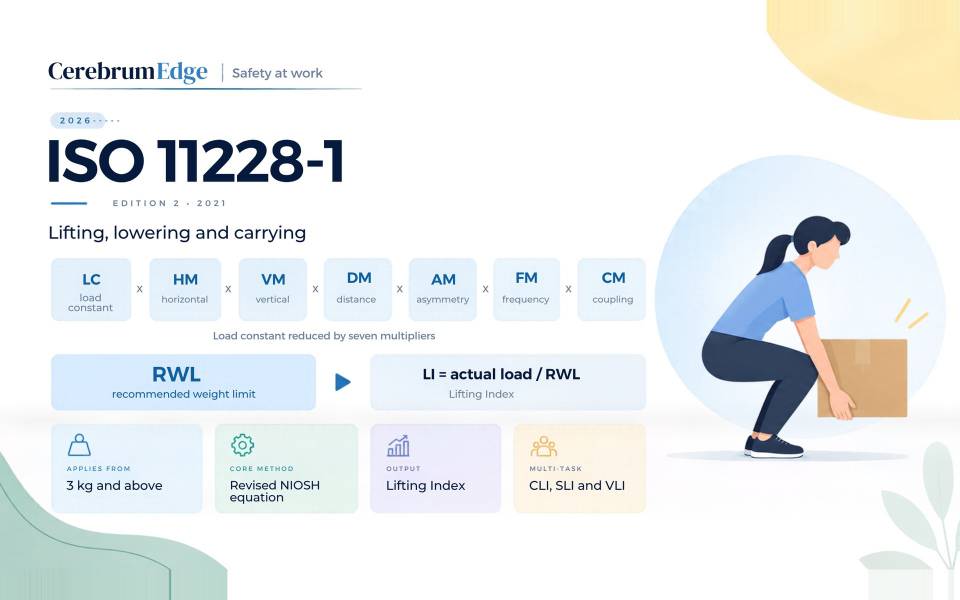
ISO 11228-1:2021 sets recommended limits for manual lifting, lowering and carrying of objects of 3 kg or more. Its computational core is the Revised NIOSH Lifting Equation, which reduces a load constant by seven multipliers to a Recommended Weight Limit; the actual load divided by that limit gives the Lifting Index.
The standard specifies recommended limits for manual lifting, lowering and carrying, taking intensity, frequency and duration into account. It applies to objects of 3 kg or more at moderate walking speed of 0.5 to 1.0 m/s on a horizontal level surface, is based on an 8 h working day but covers prolonged times up to 12 h, and addresses combined lifting, lowering and carrying tasks within a shift.
| Boundary | What the standard assumes |
|---|---|
| Mass | Objects of 3 kg or more. Below that, repetitive handling routes to ISO 11228-3 instead |
| Carrying speed | Moderate walking speed of 0.5 to 1.0 m/s on a horizontal level surface |
| Shift length | Based on an 8 h working day, with coverage extending to prolonged times up to 12 h |
| Task combination | Addresses lifting, lowering and carrying combined within a shift, not each in isolation |
| Population | Healthy adults. Pregnancy and disability are outside scope and need a separate accommodation process |
| Assistance | Excludes handling assisted by lift-assistive devices such as exoskeletons |
The boundaries are where most misapplication happens. A two-person lift, a load handled from a moving conveyor, or a carry up a ramp all sit outside the assumptions above. The standard does not cover them, and the defensible response is to record the gap in the assessment rather than apply the equation anyway and treat the number as a verdict.
How the Revised NIOSH Lifting Equation is built
Its computational core is the Revised NIOSH Lifting Equation. Here is its anatomy.
Two properties of the multiplier set matter more than the arithmetic. Every multiplier runs between 0 and 1, so each one can only reduce the load constant — there is no combination of favourable conditions that raises the limit above it. And a multiplier of zero does not mean maximum risk; it means the task falls outside the equation's validated range and cannot be assessed with it. An assessment that reports a Lifting Index derived through a zero multiplier is reporting a number the method cannot support.
| Multiplier | What it measures | What usually drives it down on a real shop floor |
|---|---|---|
| HM horizontal | Distance of the load from the ankles at origin and destination | Reaching over a conveyor guard, a pallet edge, or into the back of a deep bin |
| VM vertical | Height of the hands at the start of the lift | Floor-level picks and above-shoulder placement in the same task |
| DM distance | Vertical travel of the load | Floor to overhead racking in one movement |
| AM asymmetry | Trunk twist angle | Fixed-feet layouts where the operator turns rather than steps |
| FM frequency | Lifts per minute and duration of the lifting period | Takt increases that never trigger a re-assessment |
| CM coupling | Quality of the grip on the load | Shrink-wrapped cases, no handles, cold or wet surfaces |
The multi-task indices most assessments are missing
Changed from ISO 11228-1:2003: the scope was revised to include lowering; risk estimation expanded; Annexes A, B and C expanded; Annexes D to I added, bringing extensions of the RNLE, more lifting and carrying examples, and detailed scientific background with recommended interpretation of the RNLE.
The practical significance of that list is easy to miss. Edition 1 had no machinery for jobs made of several different lifts. A single-task Lifting Index describes one lift, repeated; it cannot represent a picker who handles forty different cartons from four rack levels across a shift. The 2021 edition adds three extensions for exactly that case.
| Index | When it applies | Typical setting |
|---|---|---|
| Single-task LI | One lift, repeated under stable conditions | A fixed packing station with one carton size |
| Composite (CLI) | A small number of distinct lifting tasks in the same job | A line feeder loading three component types from three positions |
| Sequential (SLI) | Tasks performed in defined blocks across the shift | Rotation between decant, pick and palletise stations |
| Variable (VLI) | Many combinations of weight, height and distance in no fixed order | Mixed-SKU order picking, the hardest case and the most common one |
The exposure this creates is quiet. If your assessment methodology predates 2021 and your operation runs mixed-SKU picking, you are almost certainly under-assessing — not because anyone cut corners, but because the method in use has no way to represent the job. The symptom is a file of single-task assessments for a workforce that never performs a single task. Checking for it costs an afternoon: pull the ten highest-throughput jobs and ask whether each one was assessed as the variable job it actually is.
Where Part 1 stops and another standard starts
Lifting rarely arrives alone. The same order picker who fires ISO 11228-1 on carton handling also pushes a roll cage, which is ISO 11228-2; runs a repetitive scan-and-label action, which is ISO 11228-3; and holds a sustained trunk flexion at low racking, which is ISO 11226. The routing gates are cumulative, not exclusive, and a job assessed only against Part 1 leaves most of its exposure undocumented.
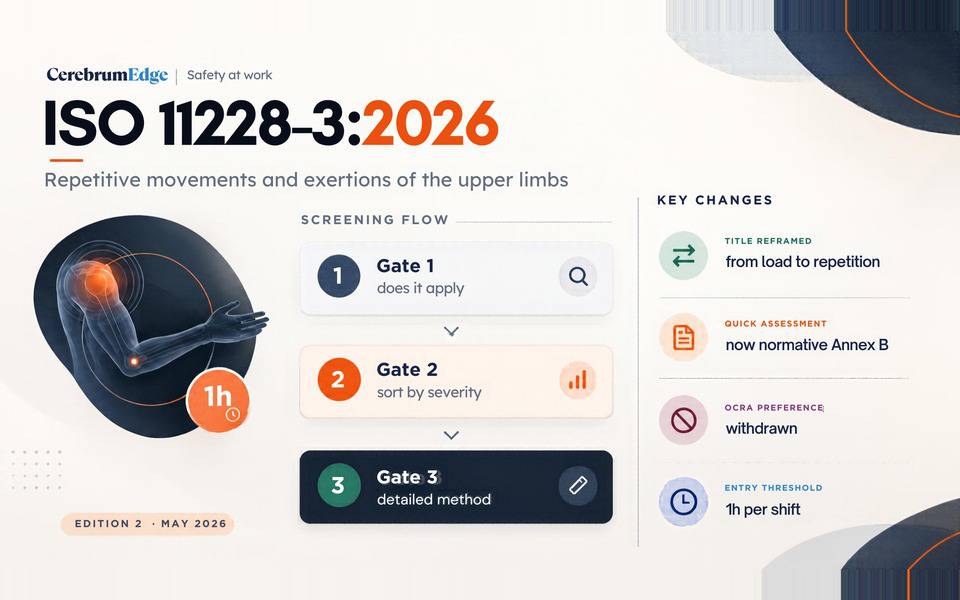
Two interfaces are worth watching in particular. Loads under 3 kg handled repetitively belong to Part 3, not here. And where repetitive upper-limb work involves masses of 3 kg or more, ISO 11228-3:2026 is reported to require integration with Part 1 rather than a Part 3 assessment in isolation — covered in what changed in ISO 11228-3:2026. The complete ISO ergonomics framework sets out the full routing logic, and the ISO 45001 mapping covers where the records belong.
What automated assessment can and cannot do here
Variable lifting is a volume problem before it is a calculation problem. Characterising a mixed-SKU job properly means capturing many lifts, not one representative lift chosen by whoever was on site that day. ErgoEdge scores lifting tasks from smartphone video using the NIOSH equation, which makes that breadth of capture affordable and keeps the method identical between the pre-control and post-control assessment — the comparison ISO 45001 Clause 9.1 asks you to evidence. The industry pages set out where lifting exposure concentrates by sector.
What it does not do is decide which index the job needs. Whether a job is composite, sequential or variable is an analytical judgement about how the work is organised, and getting it wrong invalidates the result regardless of how accurately each individual lift was scored. Load weight still has to come from a real source rather than an estimate. And as with every method in the family, no ISO standard defines a measurement tolerance for joint angles derived from computer vision, so no vendor can claim conformity on accuracy grounds. Automation supplies coverage, consistency and records; the method selection and the control decision stay with a qualified ergonomist. The FAQ lists the methods supported today.
Primary sources
ISO catalogue pages, which show the live stage code: ISO 11228-1 · ISO 11228-2 · ISO 11228-3 · ISO 11226 · ISO 45001
Frequently asked questions
What is the Recommended Weight Limit?
The Recommended Weight Limit is the load a healthy worker could lift repeatedly under the assessed conditions without raising the risk of lifting-related low back pain. It is calculated by reducing a load constant by seven multipliers covering horizontal and vertical position, travel, asymmetry, frequency and grip quality.
What does a Lifting Index above 1 mean?
The Lifting Index is the actual load divided by the Recommended Weight Limit. Above 1, the task exceeds the recommended limit and risk rises with the value. It is a comparative indicator rather than a safety threshold, so use it to prioritise redesign rather than to certify a task as safe.
Does ISO 11228-1 apply to loads under 3 kg?
No. Part 1 covers objects of 3 kg or more. Repetitive handling of lighter loads routes to ISO 11228-3 instead. Where repetitive upper-limb work involves masses at or above 3 kg, the 2026 edition of Part 3 is reported to require integration with Part 1.
What changed in ISO 11228-1:2021?
Edition 2 added composite, sequential and variable lifting indices for multi-task work, extended coverage to shifts beyond eight hours, and excluded handling assisted by devices such as exoskeletons. Assessment methods predating 2021 have no way to represent a variable-task job.
Read next
ISO ergonomics standards: the complete 2026 framework
ISO 11228-3:2026 — what changed and what it means for your assessments
Status claims here were checked in September 2026. Verify the current stage code on the ISO catalogue page before relying on any of them. This article is a technical reference and is not legal advice.