ISO ergonomics standards: the complete 2026 framework
A working reference for the ISO ergonomics standards that govern physical workload — what each one covers, which tasks trigger it, how the editions have changed, and how the whole set connects to an ISO 45001 management system. Written to be read once end to end and then returned to in pieces.
How this reference is verified
Every status claim here was checked against the ISO catalogue entry, the standard's published foreword or an official preview in September 2026. Where a claim rests on draft-stage text or on secondary reporting, the sentence says so in plain words. Two of the documents covered are in active revision, so check the live stage code on the ISO catalogue page before relying on any status claim — including ours.
What ISO ergonomics compliance actually means
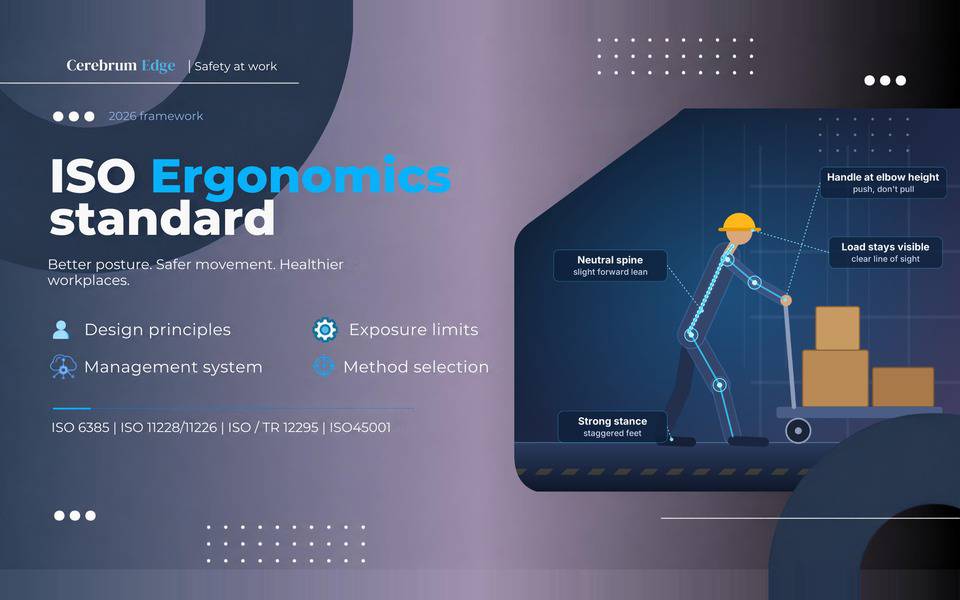
The ISO ergonomics standards form four layers: ISO 6385 sets design principles, ISO 11226 and ISO 11228-1/-2/-3 set exposure limits for posture, lifting, pushing and repetitive work, ISO/TR 12295 and 12296 guide method selection, and ISO 45001 provides the certifiable management system that contains them.
| Standard | What it covers | What triggers it | Current edition |
|---|---|---|---|
| ISO 6385 | Design of work systems — principles, not numbers | Any new or modified work system | 2016, Ed. 3 |
| ISO 11226 | Static working postures | Posture held longer than 4 s with minimal external force | 2000, revision opened April 2026 |
| ISO 11228-1 | Lifting, lowering and carrying | Objects of 3 kg or more | 2021, Ed. 2 |
| ISO 11228-2 | Whole-body pushing and pulling | Two-handed push or pull, standing or walking | 2007 + Amd 1:2022, Ed. 2 drafting |
| ISO 11228-3 | Repetitive movements and exertions of the upper limbs | Repetitive upper-limb work of 1 h or more per shift | 2026, Ed. 2 — new |
| ISO/TR 12295, 12296, ISO/TS 20646 | Application guidance, including people-handling in healthcare | Choosing between the exposure standards | 2012–2014 |
| ISO 45001 | OH&S management system — the only certifiable layer | Certification, or a structured OH&S programme | 2018, revision at DIS |
Start with the thing that trips up most programmes: you cannot be certified to ISO 11228 or ISO 11226. They are technical recommendation standards with no conformity assessment scheme behind them. There is no auditor who issues an ISO 11228 certificate, and any consultant offering one is selling something that does not exist.
ISO 45001 is different. It is a management system standard, it is certifiable, and it is audited. But read it closely and you will notice it never tells you how to assess a lifting task. Clause 6.1.2 requires you to have a process for hazard identification; it does not supply the biomechanics. That gap is exactly where the 11226 and 11228 family lives.
So "compliance" resolves into three distinct routes, and the first thing any organisation should do is work out which ones it is actually in.
| Route | How it binds you | Worked example |
|---|---|---|
| Legal incorporation | National law names the standard as a technical reference, so following it is how you discharge a statutory duty | Italy: Allegato XXXIII of D.Lgs. 81/2008 is reported to treat ISO 11228 parts 1, 2 and 3 as technical references for manual handling under art. 168 c.3 |
| State-of-the-art evidence | Law sets an outcome, not a method. The standard is how you show a competent assessment was done | UK Manual Handling Operations Regulations; Australian WHS Regulations; US General Duty Clause |
| Management system conformity | Certification requires a documented, effective hazard process. The ergonomics standards are the credible content inside it | ISO 45001 Clauses 6.1.2, 8.1.1, 8.1.2 |
A fourth route is arriving for anyone who builds or substantially modifies machinery sold into Europe, and it deserves its own flag because the date is close. Regulation (EU) 2023/1230 applies from 20 January 2027, replacing Machinery Directive 2006/42/EC with no transition period for placing new machinery on the market. Its ergonomics requirements go further than the Directive's: manufacturers must minimise not only physical but also mental strain on operators, on secondary reporting we have not verified against the Regulation text. The European Commission adopted the standardisation request to CEN and CENELEC on 20 January 2025, and most of the harmonised standards currently cited under the Directive are expected to be cited under the Regulation during the fourth quarter of 2026, on current reporting.
The four layers of ISO ergonomics standards
Four layers, and confusion usually comes from mixing them. One umbrella design standard sets principles. Four exposure standards set numbers. Three application documents tell you how to use the others. Two management standards wrap the whole thing in a governable system.
Status register
Two of these documents are in active revision right now, so check the live stage code rather than trusting a date in any article, including this one. Every ISO catalogue page shows the current stage.
| Standard | Ed. | Status | Supersedes |
|---|---|---|---|
| ISO 6385:2016 | 3 | Published | ISO 6385:2004 |
| ISO 11226:2000 + Cor 1:2006 | 1 | Confirmed 2018; moved to stage 90.92 to be revised on 3 April 2026 | — |
| ISO 11228-1:2021 | 2 | Published | ISO 11228-1:2003 |
| ISO 11228-2:2007 + Amd 1:2022 | 1 | Confirmed 2021; now stage 90.92, Ed. 2 at committee draft | — |
| ISO 11228-3:2026 | 2 | Published 8 May 2026, 45 pp | ISO 11228-3:2007 |
| ISO/TR 12295:2014 | 1 | Published; describes the superseded Part 3 | — |
| ISO/TR 12296:2012 | 1 | Published | — |
| ISO/TS 20646:2014 | 1 | Published | — |
| ISO 45001:2018 | 1 | DIS ballot opened March 2026; publication expected 2027 | OHSAS 18001 |
| ISO 45003:2021 | 1 | Published | — |
Which ISO standard applies to your task
The standards are partitioned by exposure mechanism, not by body region, industry or job title. This is the single most important structural fact, and it is why people who go looking for "the warehouse standard" or "the shoulder standard" never find one. You do not pick a standard by what the worker is called. You pick it by what the physics of the task is doing to them.
Work through the gates below for each task, not for each job. A single job routinely fires three of them.
The mistake that costs most. Practitioners treat the gates as a menu and stop at the first YES. They are cumulative. An order picker who lifts 5 kg cartons, pushes a roll cage, and scans with a repetitive wrist action fires Parts 1, 2 and 3 in the same job, and assessing only the lifting leaves two thirds of the exposure undocumented.
Threshold quick reference
| Standard | Entry threshold | Explicitly out of scope |
|---|---|---|
| 11228-1 | Objects 3 kg or more; walking 0.5–1.0 m/s on a horizontal level surface; 8 h day, extendable to 12 h | Holding without walking; pushing or pulling; handling while seated; people or animals; exoskeleton-assisted lifting; pregnancy; disability |
| 11228-2 | Whole-body force exertion, standing or walking, one person, two hands, smooth and controlled, object in front | Seated exertion; external supports; jerky or sustained forces; two-person pushes |
| 11228-3 | Repetitive upper-limb tasks totalling 1 h or more per shift, from preview text; secondary sources also describe shorter durations where force is significant | Lift-assistive devices including exoskeletons; pregnancy; disability |
| 11226 | Posture maintained longer than 4 s with slight or no variation around a fixed force level | Anything beyond minimal external force exertion |
The standards one by one
ISO 6385:2016 — the parent
Everything else derives from this one. It calls itself the core ergonomic standard for work systems from which many others on specific issues are derived, and it establishes fundamental principles for designing work systems across the full life cycle: conception, development, realisation and implementation, utilisation, maintenance and support, and decommissioning.
For a compliance programme its practical value is that it justifies intervening at design time rather than after an injury. If you need to argue internally for ergonomics input at the industrialisation stage of a new line, this is the standard to cite.
Changed from ISO 6385:2004: terms aligned with ISO 26000; subclauses 3.2, 3.7 and Clause 4 technically revised; the life cycle of a work system introduced in 3.2; a principle of adjustment added to 3.7 with validation replaced by verification; a new subclause on conformity added to Clause 4.
ISO 11226:2000 — static working postures
This standard sets recommended limits for static working postures held with no or only minimal external force exertion, taking body angles and time into account. Its recommendations are based mainly on experimental studies of musculoskeletal load, discomfort and pain, and endurance and fatigue.
The structural feature that distinguishes it from every observational scoring tool is that body segments and joints are evaluated independently. There is no composite score. Each segment gets its own verdict, and a segment that fails is not offset by five segments that pass.
Trunk posture, as an illustration of how the tables read:
| Characteristic | Verdict |
|---|---|
| Asymmetric trunk (axial rotation or lateral flexion of thorax vs pelvis) | Not recommended |
| Inclination greater than 60° | Not recommended |
| Inclination 20–60°, no full trunk support | Go to step 2 |
| Inclination 20–60°, with full trunk support | Acceptable |
| Inclination 0–20° | Acceptable |
| Backward inclination without full trunk support | Not recommended |
| Sitting with convex lumbar spine | Not recommended |
Source: ISO 11226:2000 Table 1. Head posture follows the same pattern in Tables 3 and 4, with the Frankfurt plane as the neutral reference.
Two qualifiers change how you write up a result. An "acceptable" verdict holds only if postural variation is also present, and the standard still expects you to move closer to neutral where you can. And the standard opens with a design-level requirement that work offer sufficient variation between and within sitting, standing and walking, avoiding kneeling and crouching wherever possible, while warning that introducing postural variation must not create monotonous repetitive work. That last clause is an elegant trap: you cannot solve a static posture problem by converting it into a repetition problem.
Changes and status: no new edition since 2000. Technical Corrigendum 1 issued 2006; confirmed in 2018; moved to stage 90.92, International Standard to be revised, on 3 April 2026. Nothing has been published yet, so cite it as "ISO 11226:2000, revision initiated 2026".
ISO 11228-1:2021 — lifting, lowering and carrying
The standard specifies recommended limits for manual lifting, lowering and carrying, taking intensity, frequency and duration into account. It applies to objects of 3 kg or more at moderate walking speed of 0.5 to 1.0 m/s on a horizontal level surface, is based on an 8 h working day but covers prolonged times up to 12 h, and addresses combined lifting, lowering and carrying tasks within a shift.
Its computational core is the Revised NIOSH Lifting Equation: seven multipliers reduce a load constant to a Recommended Weight Limit, and the actual load divided by that limit gives the Lifting Index. Each multiplier runs from 0 to 1 and can only reduce the limit, and a multiplier of 0 makes the task unassessable rather than merely risky.
The 2021 edition matters more than a version bump suggests. Edition 1 had no sequential, composite or variable lifting index machinery. If your assessment methodology predates 2021 and your warehouse runs mixed-SKU picking, you are almost certainly under-assessing, because a single-task LI cannot represent a variable-task job.
Full breakdown of ISO 11228-1 and the NIOSH lifting equation →
ISO 11228-2:2007 — pushing and pulling
The most tightly bounded standard in the family, and the one most often applied outside its own scope. It gives recommended limits for whole-body pushing and pulling, based on experimental push-pull studies of musculoskeletal loading, discomfort and pain, and endurance and fatigue. The restrictions are explicit: whole-body force exertions while standing or walking, by one person, with two hands, to move or restrain an object, applied smoothly and in a controlled way, without external supports, on objects in front of the operator, in an upright and not seated position.
Read that list against a real shop floor and a striking number of push-pull tasks fall outside it: two-person cage moves, seated pallet-truck operation, jerky starts on a sticky castor, pulling a load sideways past an obstruction. The standard does not cover them, and pretending otherwise is worse than recording the gap honestly.
Changes: still Edition 1, but Amendment 1:2022 altered two provisions. Clause 3.2.1.1 now advises that smooth continuous force exertions should be applied while avoiding jerky movements and long duration, with sustained forces avoided where possible because they increase risk of muscle or whole-body fatigue; and list item d) in A.2.2 was replaced with guidance on matching population limits to the actual worker population. The standard now sits at stage 90.92 with an Edition 2 committee draft in progress under a project registered in April 2024.
ISO 11228-3:2026 — repetitive upper limb work
This is the newest document in the family and the one that changes practice most. Note first that the title moved from Handling of low loads at high frequency to Repetitive movements and exertions of the upper limbs. That is not cosmetic. The old title framed the risk as a property of the load; the new one frames it as a property of repetition, force, posture, duration and recovery acting together. Modest exertions repeated without recovery generate biomechanical overload whether or not anything you would call a "load" is involved.
ISO's own change note lists three items: addition of an assessment method in Annex B at Clause B.3 and Figure B.1; addition of different methods presented in Table C.1 providing guidance to the user for application; and addition of inclusion and validation criteria for the different methods in Table C.2.
What those three lines mean in practice is a change of philosophy. The 2007 edition identified three detailed methods for repetitive high-frequency hand exertions — OCRA, the ACGIH Hand Activity Level, and the Strain Index — and preferred OCRA. That preference drew published criticism in Scandinavian Journal of Work, Environment & Health for being stated without a scientific basis or comparison on reliability and strength of association with musculoskeletal disorders, even though such comparisons existed in the literature. The 2026 edition replaces the single preferred method with a screened menu.
The eligibility bar in Annex A is demanding, as far as the preview text shows. A tool must consider, directly or indirectly, the relevant risk factors including force, posture, repetition, frequency, recovery periods, movements and duration or derivatives such as duty cycle; it must apply to two or more upper-limb body parts among fingers, hands, wrists, arms, elbows and shoulders; it should be based to the largest extent on findings from peer-reviewed scientific literature; and its application must not be restricted to a single type of work task or occupation.
Worth testing your own toolkit against. Run each method your organisation currently uses through those four criteria. Several popular observational scoring tools fail on recovery and duration handling alone. That is a defensible, standards-anchored reason to retire or re-scope a method, and a much stronger internal argument than preference.
| Dimension | 2007, Edition 1 | 2026, Edition 2 |
|---|---|---|
| Title and framing | Handling of low loads at high frequency | Repetitive movements and exertions of the upper limbs |
| Detailed method | OCRA preferred; HAL and Strain Index named alongside | Criteria-screened menu, with validation status documented per method |
| Quick assessment | Lived in application material, notably ISO/TR 12295 | Normative Annex B of the standard itself |
| Evaluator burden | Apply the preferred index | Justify the tool against task, sector, exposure, complexity and validation level |
The withdrawal effect matters for your documents. The 2007 edition is superseded. Any assessment that cites "ISO 11228-3" without an edition year is now ambiguous. Existing OCRA-only assessments covering borderline jobs, multi-task work, complex rotations, high-force stations or non-industrial settings should be re-examined against the 2026 structure. Re-examination is not the same as redoing everything from scratch.
What changed in ISO 11228-3:2026, clause by clause →
The application documents
ISO/TR 12295:2014 guides users of the ISO 11228 series and ISO 11226 in selecting and using the appropriate standard. It is genuinely useful and it has a problem: it has not been revised, so it now describes a Part 3 that no longer exists. Use it for the Part 1, Part 2 and 11226 selection logic, and disregard its Part 3 material.
ISO/TR 12296:2012 covers manual handling of people in the healthcare sector, aiming to improve caregivers' conditions by decreasing biomechanical overload risk while accounting for patients' care quality, safety, dignity and privacy. It applies to moving adults and children in healthcare settings, with some recommendations extending to home care, emergency care, voluntary caregivers and cadaver handling, and it does not apply to object or animal handling. ISO 11228-1 explicitly excludes handling people and points here instead. If you run a hospital, care home or ambulance service, this is your document, not Part 1.
ISO/TS 20646:2014 provides guidance on properly utilising the various ergonomics standards concerning musculoskeletal workload, helping develop activities to reduce or optimise it based on risk assessment. It makes the useful point that preventing musculoskeletal workload is not always a matter of reducing load, and that the approach also involves assessing work environment and organisation as a system. It does not certify complete prevention of health problems.
Related standards outside the core set
Three sit close enough to matter. The EN 1005 series (CEN, not ISO) covers human physical performance in machinery design and is harmonised under the Machinery Directive, so it binds machine builders rather than end users — and its harmonised status is in flux as the Machinery Regulation arrives. ISO 9241 covers display screen and human-system interaction work. ISO/TR 7015:2023 addresses WMSD prevention in construction, which is the sector where task-level assessment is hardest to run at scale; we cover that problem on the construction ergonomic risk assessment page.
How ISO ergonomics standards fit into ISO 45001
ISO 45001 gives you the governance loop. The ergonomics standards give you the technical content that makes the loop credible. An auditor will not ask whether you used ISO 11228-1; they will ask how you identified the hazard, how you determined the control was adequate, and how you know it worked. The standards are your answer to all three.
In practice each artifact has a home in the cycle. Plan takes the task inventory, the routing record and the MSD risk register. Do takes the controls applied in hierarchy order, assessor competence evidence and worker consultation on the assessment itself, not only on its outcome. Check takes post-intervention re-assessment using the same method, leading indicators rather than MSD incidence alone, and an internal audit of the assessment process. Act takes the standards-watch process and feeds findings back to the design stage, closing the loop to ISO 6385.
Clause-by-clause mapping and the eight-phase implementation programme →
The control hierarchy the 2026 edition insists on
Clause 8.1.2 of ISO 45001 requires controls applied in hierarchy order, and ISO 11228-3:2026 restates the same ordering for MSD risk with unusual firmness: eliminate the repetitive task where possible through mechanisation, automation, robotics, equipment and tool redesign, layout changes, force reduction and posture optimisation; then intervene organisationally through break distribution, adequate recovery, genuinely designed job rotation, task enrichment, balancing actions between both limbs, removing unnecessary actions and revising cadence; and only then, integrated with the rest, information, instruction and training. That ordering comes from summaries of the 2026 text rather than from the clause itself, so read the standard before quoting it.
ISO 45003 and the coming 45001 revision
ISO 45003:2021 gives guidelines for managing psychosocial risk within an OH&S management system based on ISO 45001, applicable to organisations of all sizes and sectors. It is guidance, not certifiable. It belongs in this article because ISO 11228-3:2026 now names work organisation and psychosocial factors inside its own risk-factor set, which means the physical and psychosocial assessments can no longer be run as unrelated exercises by unrelated teams.
The ISO 45001 revision is live and at DIS ballot, with publication anticipated in 2027 and a transition deadline that would fall around 2030 if the usual three years apply. The practical read is not to wait: a hazard register that already treats physical MSD exposure and psychosocial exposure as one integrated problem will need far less rework. Draft status, expected timing and how to prepare →
Legal status by jurisdiction
The same technical standard carries very different legal weight depending on where the work happens. This table is a starting point for your legal register, not a substitute for local advice.
| Jurisdiction | Governing instrument | Standing of the ISO ergonomics standards |
|---|---|---|
| EU | Framework Directive 89/391/EEC; Manual Handling 90/269/EEC; DSE 90/270/EEC; Machinery Regulation (EU) 2023/1230 from 20 Jan 2027 | Method-agnostic duty to assess. For machinery, the harmonised-standards route gives presumption of conformity, and that list is being rebuilt for the Regulation, with publication reported as expected in Q4 2026. New standards published in the transition are expected to carry both an Annex ZA for the Directive and an Annex ZB for the Regulation. |
| Italy | D.Lgs. 81/2008, Titolo VI, art. 168 c.3, Allegato XXXIII | Reported as the strongest case of legal incorporation: Allegato XXXIII treats ISO 11228 parts 1, 2 and 3 as technical references. The 2026 Part 3 therefore flows into Italian risk assessment directly, and SIML has reportedly called for free access to the text under art. 10 c.1 lett. a of D.Lgs. 159/2025 given the roughly €205 purchase cost. |
| UK | MHSWR 1999; MHOR 1992; DSE Regs 1992 | HSE built its own toolset rather than adopting ISO methods: the MAC tool for manual handling, the ART tool for repetitive upper-limb tasks, and the risk filter and assessment worksheets introduced with the revised HSG60 in 2002. ISO standards are acceptable evidence, not the regulator's own route. |
| US | OSH Act General Duty Clause §5(a)(1); state plans | No federal ergonomics standard. OSHA cites ergonomic hazards under the General Duty Clause and issues hazard alert letters, with industry guidelines for poultry processing, retail grocery, nursing homes and shipyards; the original rule was rescinded under the Congressional Review Act. Several state plans go further. Secondary sources describe Minnesota Stat. §182.677, effective 1 January 2024, as requiring written ergonomics programmes with risk assessments in warehouse distribution, meatpacking and poultry, and licensed healthcare above headcount thresholds. |
| India | Occupational Safety, Health and Working Conditions Code, 2020 | The Code came into force on 21 November 2025, consolidating 13 previous laws and applying to establishments with ten or more workers; full enforcement depends on central and state rules still being finalised. No reference to the ISO ergonomics standards was found, and employer duties are framed generally as maintaining a workplace free from hazards. Notably, the Code provides that where no Indian standard exists for an article, the article may conform to the standard adopted at national level in the country of import — a route by which ISO ergonomics criteria can enter Indian practice through imported plant. |
Where automated assessment fits — and where it does not
The router above sets a workload problem before it sets a technical one. Assessing by task rather than by job means hundreds of assessments in a mid-sized plant, not the sampled dozen most programmes actually run, and the gap between those two numbers is where undocumented exposure lives. That is the specific problem video-based scoring addresses: coverage at task level, and the same method applied the same way every time.
ErgoEdge scores ergonomic risk from video recorded on a standard smartphone, with no wearables on the worker and no specialist on site. Three things follow that are useful in a standards context. Task-level coverage becomes affordable, so the routing sheet can record a verdict for every task instead of a sample. Re-assessment uses the identical method and removes inter-rater drift from the before-and-after comparison, which is what makes ISO 45001 Clause 9.1 evidence credible. And each assessment leaves a timestamped, method-tagged record, which is the artifact an auditor asks for when they ask how you knew the control worked. Where ergonomic exposure sits alongside behavioural hazards, SafetyEdge covers the CCTV-based side of the same shop floor.
The honest mapping matters more than the capability list, because the standards ask for things no assessment tool produces.
| Standard | Relevant automated output | What the standard still needs from you |
|---|---|---|
| ISO 11228-1 | NIOSH Lifting Equation scoring and Lifting Index | Composite, sequential and variable LI judgement for multi-task and mixed-SKU jobs |
| ISO 11228-3:2026 | ART scoring for repetitive upper-limb tasks | The normative Annex B quick assessment, and a written Annex A justification for whichever detailed method you select |
| ISO 11226 | Posture data by body segment across the work cycle | The two-step, segment-independent verdict. No composite score substitutes for it |
| ISO 11228-2 | Not addressed | Push and pull force measurement sits outside video-based posture scoring |
| ISO/TR 12296 | Not addressed | People-handling is out of scope for ISO 11228-1 and for automated scoring alike |
Two limits are worth stating outright. RULA and REBA are widely used screening tools but they are not ISO methods, and tested against the Annex A criteria quoted above they are weak on recovery and duration — treat them as screening, not as standards-conformant assessment. And as the limitations section below sets out, no ISO standard defines a measurement tolerance for joint angles derived from computer vision. What automation supplies is coverage, consistency and records. Method selection, engineering judgement and the control decision stay with a qualified ergonomist. The FAQ lists which assessment methods are supported today.
Limitations of the ISO ergonomics standards
Exoskeletons are out of scope. Both ISO 11228-1 and ISO 11228-3 explicitly exclude manual handling assisted by lift-assistive devices such as exoskeletons. If you have deployed them, no ISO exposure standard currently tells you how to assess the resulting task.
Pregnancy and disability are out of scope. Stated in the same exclusions. The standards protect "nearly all healthy adults" and say so. Your accommodation process has to come from somewhere else.
No measurement tolerance is specified. ISO 11226 permits observation, photography and video, opto-electronic and ultrasound systems, inclinometers and goniometers, noting that direct observation will usually do, with the appropriate method depending on the accuracy the evaluation requires. It sets no accuracy requirement. If you derive joint angles from computer vision or IMUs, there is no standards-defined tolerance you can claim conformity against. Vendors implying otherwise are overreaching.
ISO/TR 12295 has drifted out of alignment. A 2014 application document that points readers at a withdrawn Part 3 and its OCRA-centred logic. Use it selectively.
Cost is a real barrier. A small manufacturer needing five documents faces a four-figure spend before doing any assessment.
What to do next
Five things worth doing in the next quarter, in order.
1. Get ISO 11228-3:2026 and read Annexes A, B and C. Everything else in your repetitive-work programme depends on the selection and validation criteria in Annex A, and no secondary summary is a safe substitute.
2. Audit your existing assessments for edition drift. Anything citing "ISO 11228-3" without a year, or built on the 2003 Part 1, needs a look.
3. Add edition-change as a formal re-assessment trigger in your management system, and subscribe to the ISO RSS updates on the catalogue pages linked in section 2.
4. If you place machinery on the EU market, start the Machinery Regulation gap analysis now. January 2027 has no transition period, and the ergonomics requirements have broadened to cover mental strain.
5. Merge your physical and psychosocial hazard registers before the ISO 45001 revision lands. Both the 45001 draft direction and ISO 11228-3:2026 are pushing the same way.
Frequently asked questions
Can you be certified to ISO 11228?
No. ISO 11226 and the ISO 11228 series are technical recommendation standards with no conformity assessment scheme behind them, so no auditor issues a certificate against them. ISO 45001 is the certifiable standard, and the ergonomics standards supply the technical content its risk assessments rely on.
Which ISO standard applies to manual lifting?
ISO 11228-1:2021 covers lifting, lowering and carrying of objects of 3 kg or more, using the Revised NIOSH Lifting Equation. Below 3 kg, repetitive handling routes to ISO 11228-3 instead. Pushing and pulling is ISO 11228-2, and sustained static posture is ISO 11226.
Is ISO 11226 still current?
Yes. ISO 11226:2000 remains the current edition and stays in force until a replacement publishes. It moved to stage 90.92, meaning international standard to be revised, on 3 April 2026, so a new edition is in preparation. Assessments against the 2000 text remain valid meanwhile.
Are the ISO ergonomics standards legally binding?
Not by themselves. They bind through three routes: national law naming them as a technical reference, as Italy is reported to do; contract terms requiring them; and the harmonised-standards route for machinery placed on the EU market. Elsewhere, duties are typically method-agnostic and the standards are acceptable evidence rather than a requirement.
Read next
ISO 11228-3:2026 — what changed and what it means for your assessments
ISO 11228-1 and the NIOSH lifting equation, explained
Primary sources
ISO catalogue pages, which show the live stage code for each document: ISO 6385 · ISO 11226 · ISO 11228-1 · ISO 11228-2 · ISO 11228-3 · ISO 45001 · ISO 45003
Regulatory: OSHA ergonomics standards and enforcement FAQs · European Commission, harmonised standards for machinery
Critique of the 2007 Part 3 method preference: Armstrong et al., scientific basis of ISO standards on biomechanical risk factors, Scandinavian Journal of Work, Environment & Health, 2018.
Standards statuses in this article were checked in September 2026. Two of the documents covered are in active revision, so verify the current stage code on the ISO catalogue page before relying on any status claim here. This article is a technical reference and is not legal advice.