ISO 11228-3:2026 — what changed and what to do
ISO 11228-3:2026 replaced the 2007 edition on 8 May 2026. It changed the title, made the quick assessment normative, set a formal entry threshold and stopped preferring one detailed method. This is what that means for assessments you have already written.
How this reference is verified
Claims here were checked against the ISO catalogue entry, the published foreword and ISO's own change note in September 2026. Where a point rests on draft-stage text or on secondary reporting, the sentence says so. We have not reproduced the annex contents; the standard is the only safe source for the criteria and method tables described below.
What changed in ISO 11228-3:2026
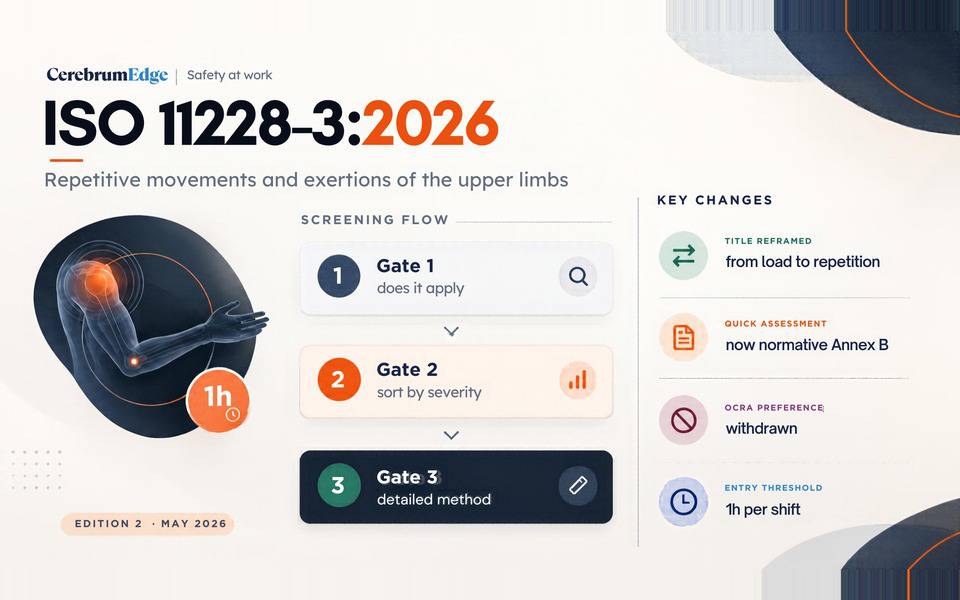
ISO 11228-3:2026 published on 8 May 2026 as Edition 2, superseding ISO 11228-3:2007. It renames the standard from handling of low loads at high frequency to repetitive movements and exertions of the upper limbs, makes the quick assessment a normative annex, sets a formal entry threshold of one hour per shift, and replaces the 2007 preference for OCRA with a criteria-screened menu of detailed methods.
| Dimension | 2007, Edition 1 | 2026, Edition 2 |
|---|---|---|
| Title and framing | Handling of low loads at high frequency | Repetitive movements and exertions of the upper limbs |
| Detailed method | OCRA preferred; HAL and Strain Index named alongside | Criteria-screened menu with documented validation status per method |
| Quick assessment | Lived in application material, notably ISO/TR 12295 | Normative Annex B of the standard itself |
| Entry criterion | Less explicit | Formal key enter at 1 h per shift |
| Evaluator burden | Apply the preferred index | Justify the tool against task, sector, exposure, complexity and validation level |
| Multi-task and rotation | OCRA noted as multi-task capable | Reported to add a dedicated annex covering daily and longer macro-cycles |
| Interface with Part 1 | Less explicit | Masses of 3 kg or more reported to require integration with ISO 11228-1 |
| Length | 76 pp | 45 pp |
Why the title change is not cosmetic
Start with the title, which moved from Handling of low loads at high frequency to Repetitive movements and exertions of the upper limbs. That is not cosmetic. The old title framed the risk as a property of the load; the new one frames it as a property of repetition, force, posture, duration and recovery acting together. Modest exertions repeated without recovery generate biomechanical overload whether or not anything you would call a "load" is involved.
The standard defines its vocabulary formally: work action as the elementary manual movements or exertions required to complete operations within the cycle, giving holding, turning, pushing and cutting as examples; alongside frequency of actions, force intensity, postures and movements, exertions, and recovery time as a period, typically of rest, allowing restoration of musculoskeletal function or recovery from fatigue. The main contributing risk factors to upper-limb WMSD are named as frequency of actions, exposure duration, postures and movement of body segments, and forces exerted. It does not cover manual handling assisted by lift-assistive devices such as exoskeletons, nor the needs of pregnant women or persons with disabilities.
The three-gate assessment procedure
The 2026 structure runs as three gates. The first decides whether the standard applies at all. The second sorts tasks into acceptable, intermediate and critical without a detailed calculation. Only the third asks you to choose and apply a detailed method — and choosing is now part of the assessment rather than a preliminary to it.
The gate that saves the most work is the second one. A critical finding at Gate 2 does not send you to a detailed method; it sends you to redesign. Programmes that calculate an index for every task, including the obviously critical ones, are spending assessment effort where the answer was already known. The same applies in reverse: a task that clears Gate 2 on every acceptability criterion needs a record, not a calculation.
From one preferred method to a screened menu
ISO's own change note lists three items: addition of an assessment method in Annex B at Clause B.3 and Figure B.1; addition of different methods presented in Table C.1 providing guidance to the user for application; and addition of inclusion and validation criteria for the different methods in Table C.2.
What those three lines mean in practice is a change of philosophy. The 2007 edition identified three detailed methods for repetitive high-frequency hand exertions — OCRA, the ACGIH Hand Activity Level, and the Strain Index — and preferred OCRA. That preference drew published criticism in Scandinavian Journal of Work, Environment & Health for being stated without a scientific basis or comparison on reliability and strength of association with musculoskeletal disorders, even though such comparisons existed in the literature. The 2026 edition replaces the single preferred method with a screened menu.
The eligibility bar in Annex A is demanding, as far as the preview text shows. A tool must consider, directly or indirectly, the relevant risk factors including force, posture, repetition, frequency, recovery periods, movements and duration or derivatives such as duty cycle; it must apply to two or more upper-limb body parts among fingers, hands, wrists, arms, elbows and shoulders; it should be based to the largest extent on findings from peer-reviewed scientific literature; and its application must not be restricted to a single type of work task or occupation.
Worth testing your own toolkit against. Run each method your organisation currently uses through those four criteria. Several popular observational scoring tools fail on recovery and duration handling alone. That is a defensible, standards-anchored reason to retire or re-scope a method, and a much stronger internal argument than preference.
Two practical cautions. Annex C lists candidate methods with application guidance and a validation status for each; we are not reproducing that list here, because the versions circulating in secondary summaries do not all agree and at least one carries an AI-assistance disclosure. Read Annex C itself before you commit a method to your procedure. And the criteria in Annex A are a screening bar for method eligibility, not a ranking — clearing them does not make a method right for your task.
Which assessments need re-examining
The withdrawal effect matters for your documents. The 2007 edition is superseded. Any assessment that cites "ISO 11228-3" without an edition year is now ambiguous. Existing OCRA-only assessments covering borderline jobs, multi-task work, complex rotations, high-force stations or non-industrial settings should be re-examined against the 2026 structure. Re-examination is not the same as redoing everything from scratch.
In priority order, the assessments most exposed to the edition change are:
| Assessment type | Why the 2026 edition changes the answer |
|---|---|
| Anything citing "ISO 11228-3" with no year | Now ambiguous on its face. An auditor cannot tell which edition you assessed against, and neither can your next assessor |
| OCRA-only assessments of borderline jobs | The 2007 preference that justified using OCRA alone no longer exists. The choice now needs a written rationale |
| Multi-task work and complex rotations | Handled by a dedicated annex in the 2026 edition covering daily and longer macro-cycles, on current reporting |
| Tasks involving masses of 3 kg or more | Reported to require integration with ISO 11228-1 rather than a Part 3 assessment in isolation |
| Non-industrial settings | Annex A requires that a method not be restricted to a single type of work task or occupation, which several popular tools are |
| Screening built on ISO/TR 12295 | TR 12295 has not been revised and still describes the superseded Part 3. The quick assessment now lives in normative Annex B |
Re-examination is not the same as redoing everything. For most tasks the honest output is a short note recording that the 2026 structure was considered, the method still meets the Annex A criteria, and the verdict is unchanged. The cases that need real work are the ones where the 2007 assessment depended on the preference that has now been withdrawn.
A migration sequence that works
1. Buy the standard and read Annexes A, B and C. Everything downstream depends on the eligibility criteria in Annex A and the method table in Annex C. No secondary summary, this one included, is a safe substitute for the text.
2. Find every document citing Part 3. Assessments, procedures, the legal and other requirements register, training material, tender responses. Add the edition year everywhere.
3. Score your current toolkit against the Annex A criteria and write the result down. Force, posture, repetition, recovery, duration; two or more upper-limb body parts; peer-reviewed basis; not restricted to one occupation. A method that fails is a method you can retire with a standards-anchored reason rather than a preference.
4. Re-run the key enter and quick assessment across the task register. This is cheap relative to detailed assessment and it re-sorts the population. Tasks that move from intermediate to critical go to redesign, not to another index.
5. Write the method-selection rationale per task. One short paragraph naming the method, the validation level and why it suits this task, sector and exposure. This is the artifact the 2026 edition adds to your evidence pack.
6. Add edition change as a formal re-assessment trigger. Part 3 is the case in point, and ISO 11226 is next — it moved to revision stage in April 2026.
Where Part 3 sits in the wider framework
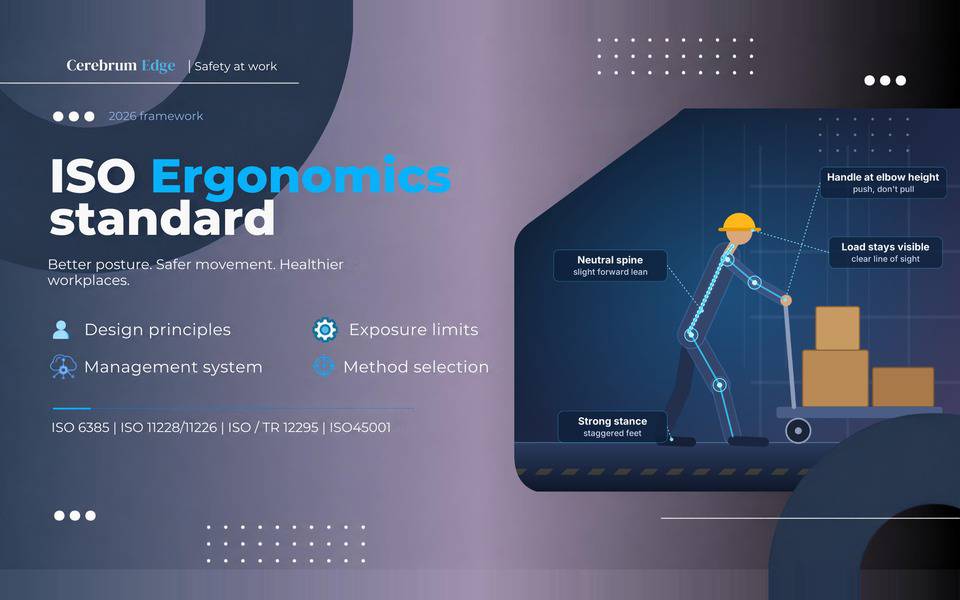
Part 3 is one of four exposure standards, and the gates that route a task to it are cumulative rather than exclusive. A warehouse order picker who lifts cartons, pushes a roll cage and runs a repetitive scan-and-label action fires ISO 11228-1, ISO 11228-2 and ISO 11228-3 in the same shift, and a sustained trunk flexion at low racking adds ISO 11226. Assessing the repetitive component alone leaves most of the exposure undocumented. The complete ISO ergonomics framework sets out the routing logic, and the ISO 45001 mapping covers where the resulting records belong in a management system.
What automated assessment can and cannot do here
The 2026 edition adds work at exactly the point where most programmes are already stretched: Gate 1 and Gate 2 have to be applied to every repetitive task, not to a sample, and the results have to be recorded either way. ErgoEdge scores repetitive upper-limb tasks from smartphone video using the ART method, which makes task-level coverage affordable and keeps the method constant between the pre-control and post-control assessment — the comparison ISO 45001 Clause 9.1 asks you to evidence.
What it does not do is the part the 2026 edition actually added. The Annex B quick assessment includes qualitative questions about work organisation and recovery that no video scores. The Annex A justification is a written argument, not an output. And where a task involves masses of 3 kg or more, Part 3 does not stand alone. Automated scoring supplies coverage, consistency and records; the method selection and the control decision stay with a qualified ergonomist. The FAQ lists the assessment methods supported today, and the industry pages set out where repetitive upper-limb exposure concentrates by sector.
Primary sources
ISO catalogue pages, which show the live stage code: ISO 11228-3 · ISO 11228-1 · ISO 11226 · ISO 45001
Critique of the 2007 method preference: Armstrong et al., scientific basis of ISO standards on biomechanical risk factors, Scandinavian Journal of Work, Environment & Health, 2018.
Frequently asked questions
When was ISO 11228-3:2026 published?
ISO 11228-3:2026 published on 8 May 2026 as Edition 2, running to 45 pages. It supersedes ISO 11228-3:2007, which is now withdrawn. The catalogue entry shows the live stage code, so check it there before citing the edition in a procedure.
Is ISO 11228-3:2007 still valid?
No. The 2007 edition is withdrawn. Assessments citing it are not automatically wrong, but they rest on a superseded document, and a citation reading simply ISO 11228-3 with no year is now ambiguous. Add the edition year to every reference you hold.
Does the 2026 edition still prefer OCRA?
No. Edition 1 named OCRA as the preferred index. The 2026 edition replaces that preference with eligibility criteria in Annex A and a menu of candidate methods in Annex C, each with its validation status recorded. Choosing a method is now part of the assessment.
What is the entry threshold for ISO 11228-3?
Repetitive upper-limb tasks totalling one hour or more per shift, from the preview text of the 2026 edition. Secondary sources also describe shorter durations qualifying where force is significant. Below the threshold, the standard does not apply and the routing record should say so.
Read next
ISO ergonomics standards: the complete 2026 framework
Status claims here were checked in September 2026. Verify the current stage code on the ISO catalogue page before relying on any of them. This article is a technical reference and is not legal advice.