ISO 45001 and ergonomics: clause-by-clause
ISO 45001 requires a process for hazard identification but supplies none of the biomechanics. This covers which clauses ergonomic risk touches, what artifact each one expects, and an eight-phase programme that produces those artifacts as a by-product of doing the work properly.
How this reference is verified
Clause numbers are from ISO 45001:2018 as published. The revision is live and clause numbering may move, so treat the mapping below as current rather than permanent. Where a point rests on draft-stage text or secondary reporting, the sentence says so.
Why ISO 45001 needs the ergonomics standards
ISO 45001 requires a process for identifying hazards and assessing OH&S risk, but it never specifies how to assess a lifting or repetitive task. The ISO 11226 and ISO 11228 standards supply that technical content. ISO 45001 is the certifiable layer; the ergonomics standards are what make its MSD risk assessments defensible.
ISO 45001 gives you the governance loop. The ergonomics standards give you the technical content that makes the loop credible. An auditor will not ask whether you used ISO 11228-1; they will ask how you identified the hazard, how you determined the control was adequate, and how you know it worked. The standards are your answer to all three.
The distinction matters when an auditor arrives. Nobody will ask whether you used ISO 11228-1, because no auditor issues a certificate against it — the exposure standards are not certifiable. What they will ask is how you identified MSD hazards, why you chose the method you chose, who was competent to apply it, and how you know the control worked. Each of those questions has an artifact behind it, and the ergonomics standards are where the artifacts come from.
Which ISO 45001 clauses ergonomic risk touches
| Clause | What it requires | What ergonomics has to supply |
|---|---|---|
| 6.1.2 Hazard identification | A process for identifying hazards on an ongoing and proactive basis | A task inventory and a routing record showing which exposure gates fired for each task, and which did not |
| 6.1.2.2 Risk assessment | Methodologies and criteria for assessing OH&S risk, defined and applied | The named assessment method per task, with a written justification for the choice |
| 7.2 Competence | Workers are competent on the basis of education, training or experience | Evidence that whoever applied the method was qualified to apply it |
| 5.4 / 7.4 Consultation | Consultation and participation of non-managerial workers | Worker input into the assessment itself, not only into its outcome |
| 8.1.2 Eliminating hazards | Controls applied in hierarchy order | A control record showing design and engineering options were considered before training |
| 9.1 Monitoring and measurement | Evaluation of OH&S performance and effectiveness of controls | Post-control re-assessment using the same method, and leading indicators rather than MSD incidence alone |
| 9.2 Internal audit | Audit at planned intervals against the organisation's own requirements | An audit of the assessment process, not just a sample of assessment outputs |
| 10.3 Continual improvement | Improvement of the OH&S management system | A standards-watch process that feeds edition changes back to design |
Clause 9.1 is where most MSD programmes are weakest. Injury counts are a lagging indicator, they move slowly, and on a single line they are statistically too sparse to show whether a control worked. A re-assessment using the identical method, giving a before-and-after exposure score for the same task, is the evidence the clause is actually asking for — and it works within a quarter rather than a year.
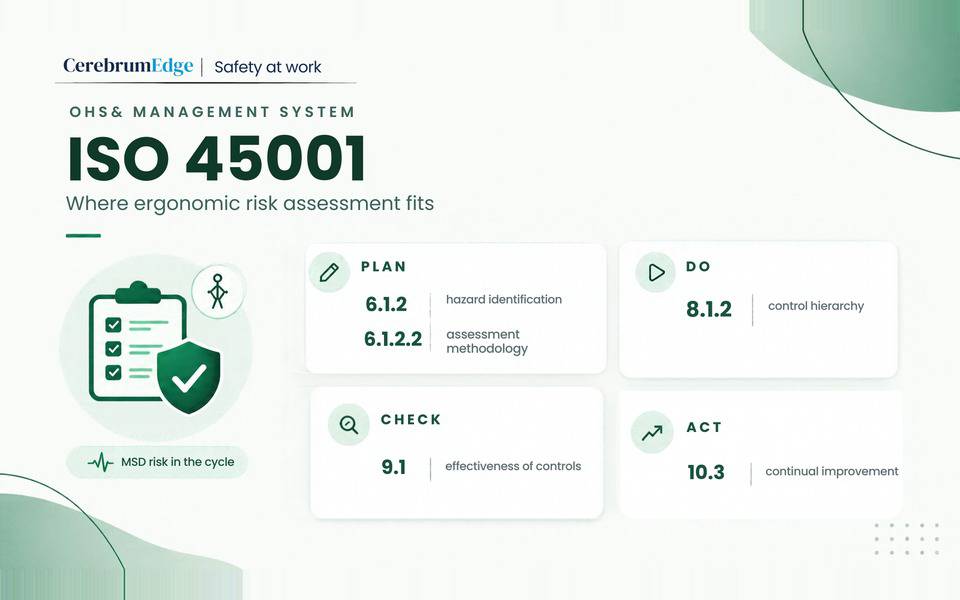
Where each artifact lands in the Plan-Do-Check-Act cycle
Two links in that loop get dropped most often. Act back to design closes to ISO 6385: findings from the floor should change how the next workstation is specified, not just how the current one is patched. And Check on leading indicators is what stops the programme from waiting for an injury to learn something.
An eight-phase implementation programme
A sequence that works, with the artifact each phase must produce. Phases 1 and 2 are where most programmes are weakest, because they are unglamorous and they determine everything downstream.
| Phase | What you do | Artifact produced | Competence needed |
|---|---|---|---|
| 1 | Task inventory. Break every job into tasks with duration, frequency and mass | Task register, one row per task not per job | Supervisor plus trained observer |
| 2 | Apply the router. Record which gates fired, and which did not | Routing sheet with negative findings recorded explicitly | Trained internal assessor |
| 3 | Screening. Quick assessment for Part 3; step 1 for 11226; initial LI for Part 1 | Screening records classifying acceptable, intermediate, critical | Trained internal assessor |
| 4 | Method selection for anything intermediate, with written justification | Method-selection rationale per task, referencing validation level | Qualified ergonomist |
| 5 | Detailed assessment | Assessment reports with indices, action levels and assumptions stated | Qualified ergonomist |
| 6 | Control in hierarchy order, design first | Change records showing which hierarchy tier each control sits in | Engineering plus ergonomist |
| 7 | Re-assess with the same method and compare | Before and after comparison, same method, same assessor where possible | Qualified ergonomist |
| 8 | Standards watch and periodic review | Legal and other requirements register with edition numbers and stage codes | EHS management |
Phases 1 and 2 decide the value of everything after them. An assessment programme built on a job list rather than a task list will miss exposure by construction, because jobs average out what tasks reveal. The routing record matters just as much: writing down which gates did not fire is what lets a future auditor, or a future assessor, see that the absence of an assessment was a decision rather than an oversight.
Re-assessment triggers that beat an annual cycle
Fixed annual cycles miss the changes that matter. Trigger a re-assessment on: any engineering or layout change to the workstation; a change in cycle time, takt or output target; a change in packaging, container or tool; a new rotation pattern; a reported symptom or MSD case on that task; introduction of an assistive device; and a new edition of the governing standard. That last trigger is the one nobody builds in, and it is the reason ISO 11228-3:2026 will catch organisations out.
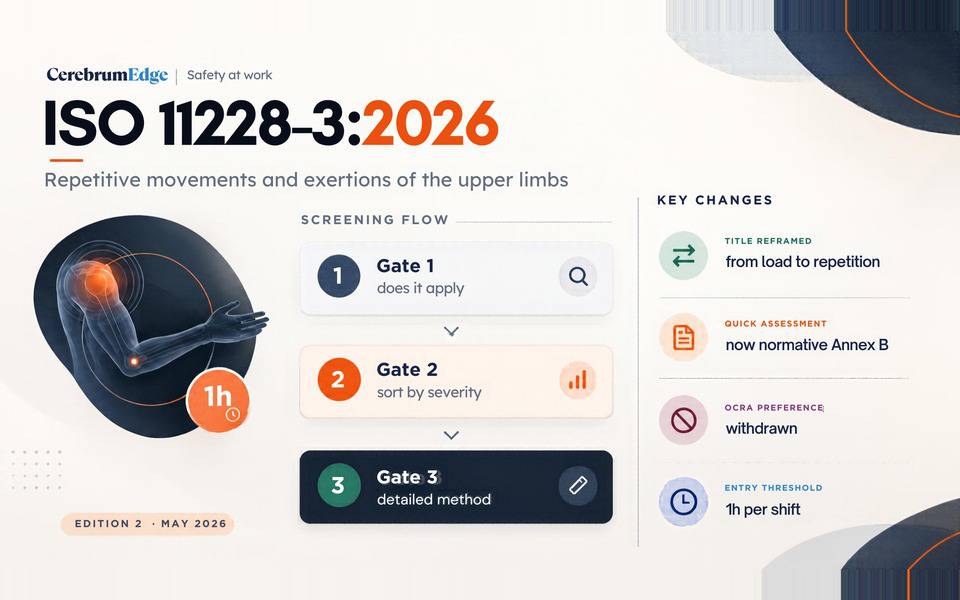
Edition change belongs on that list as a formal trigger. ISO 11228-3 is the live case — the 2026 edition withdrew the 2007 method preference that many existing assessments relied on, covered in what changed in ISO 11228-3:2026. ISO 11226 moved to revision stage in April 2026 and ISO 11228-2 has an Edition 2 committee draft in progress, so two more are coming.
Preparing for the ISO 45001 revision
The ISO 45001 revision is live. ISO/TC 283 published the first Committee Draft in July 2025, a second version of CD1 including a draft informative Annex A followed in January 2026, and the DIS ballot opened in March 2026. Publication is anticipated in 2027, and management system standards typically carry a three-year transition, which would put the deadline around 2030 — none of which is settled until publication. Draft-stage themes reported consistently include explicit focus on worker well-being rather than health and safety alone, psychosocial risk, hybrid and remote work, climate-related risk, and technological change including AI. The high-level structure is expected to be retained.
Practical read: do not wait. A hazard register that already treats physical MSD exposure and psychosocial exposure as one integrated problem will need far less rework in 2027 than one that treats them as separate annexes.
What automated assessment contributes to the evidence pack
Three clauses in the table above are satisfied by records rather than by judgement, and records are where manual programmes quietly fail. ErgoEdge scores ergonomic risk from smartphone video, which makes task-level coverage affordable at Phase 1 to 3, keeps the method identical between the pre-control and post-control assessment at Phase 7, and leaves a timestamped, method-tagged record for each one. That combination is what makes a Clause 9.1 effectiveness claim checkable instead of assertable. Where physical exposure sits alongside behavioural hazards on the same floor, SafetyEdge covers the CCTV-based side.
It contributes nothing to the clauses that turn on judgement. The Clause 6.1.2.2 method justification is a written argument. Clause 7.2 competence is about the person, not the tool — automating the scoring does not make an unqualified assessor qualified, and an auditor will ask who interpreted the result. Consultation under Clause 5.4 means workers shaping the assessment, which no platform does for you. And no ISO standard defines a measurement tolerance for joint angles derived from computer vision, so accuracy is not a conformity claim anyone can make. Coverage, consistency and records are the contribution; the judgement stays with a qualified ergonomist. The FAQ lists the methods supported today and the industry pages set out where exposure concentrates by sector.
Primary sources
ISO catalogue pages, which show the live stage code: ISO 45001 · ISO 45003 · ISO 6385 · ISO 11228-1 · ISO 11228-3
Frequently asked questions
Does ISO 45001 require ergonomic risk assessment?
Indirectly. Clause 6.1.2 requires a process for identifying hazards proactively, and musculoskeletal hazards fall within it. The standard never specifies how to assess a lifting or repetitive task, which is why the ISO 11226 and ISO 11228 standards supply the technical content behind the assessment.
Which ISO 45001 clause covers MSD hazards?
There is no dedicated clause. MSD risk runs through 6.1.2 for hazard identification, 6.1.2.2 for assessment methodology, 8.1.2 for the control hierarchy, and 9.1 for evaluating whether controls worked. Competence under 7.2 and worker consultation under 5.4 apply to the assessment itself.
Can you be certified to the ISO ergonomics standards?
No. ISO 45001 is the certifiable standard. ISO 11226 and the ISO 11228 series carry no conformity assessment scheme, so no auditor issues a certificate against them. They make your ISO 45001 risk assessments defensible rather than being certifiable themselves.
When is the ISO 45001 revision due?
The revision is live and at DIS ballot stage, with publication anticipated in 2027. If the usual three-year transition applies, the deadline would fall around 2030. None of that is settled until publication, so check the catalogue entry for the current stage code.
Read next
ISO ergonomics standards: the complete 2026 framework
ISO 11228-3:2026 — what changed and what it means for your assessments
Clause references are to ISO 45001:2018 and were checked in September 2026. The standard is in revision; verify the current stage on the ISO catalogue page. This article is a technical reference and is not legal advice.